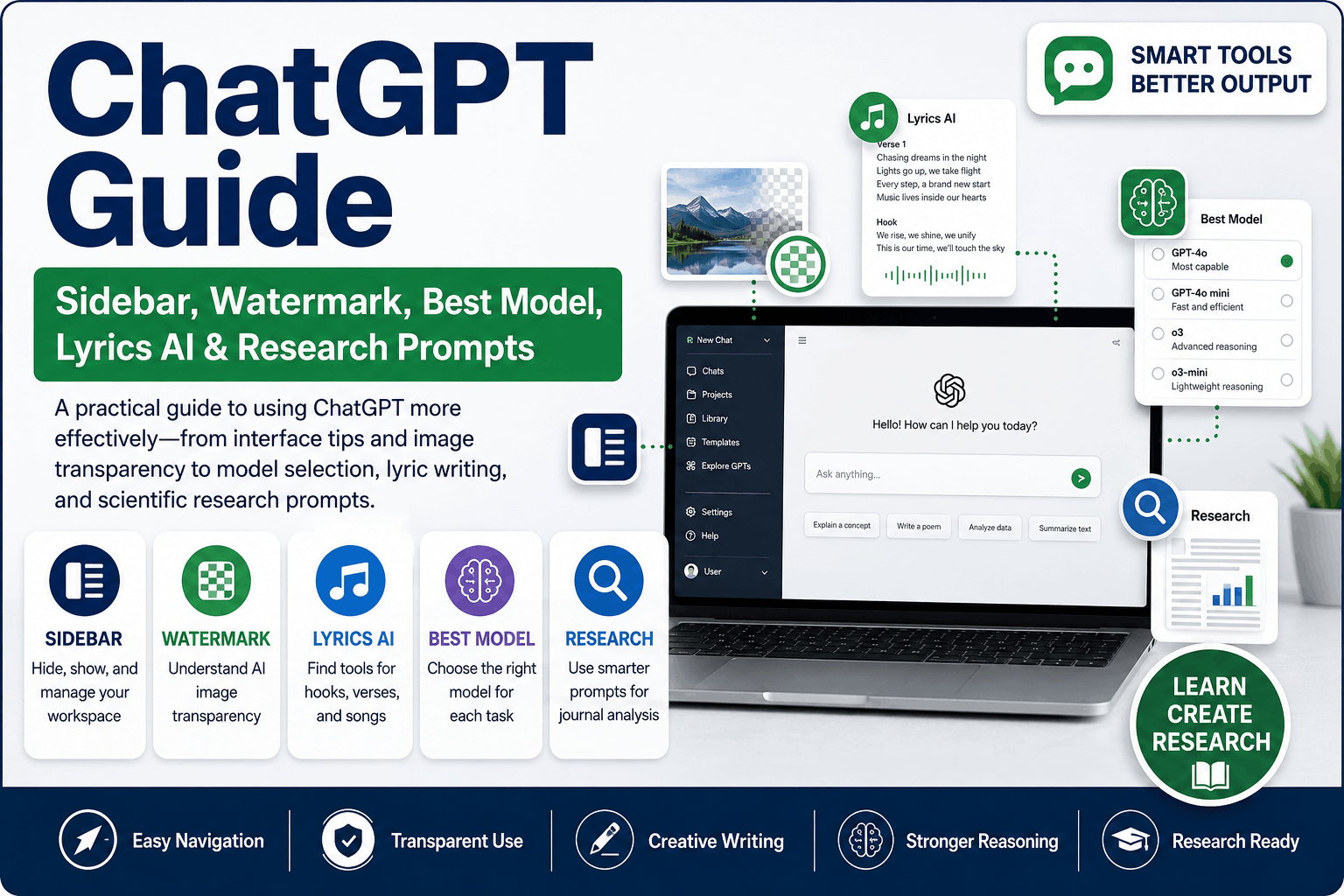
ChatGPT is one of the most popular AI tools for writing, research, creative work, productivity, and learning. Many users search for how to close sidebar on ChatGPT, how to remove ChatGPT watermark, what AI platform like ChatGPT make the best lyrics, what is the best ChatGPT model, and best prompts for ChatGPT to do research on scitentific journals.
This complete guide explains these topics in simple language, including practical steps, safe usage tips, AI model guidance, and research prompt examples. For current ChatGPT model information, OpenAI’s help center says GPT-5.5 Pro is the highest-capability GPT-5.5 option in ChatGPT for difficult tasks and long-running workflows.
How to Close Sidebar on ChatGPT
The ChatGPT sidebar shows your recent chats, projects, and conversation history. Some users want to close it for a cleaner writing area, better focus, or more screen space.
Simple Ways to Close the ChatGPT Sidebar
- Click the sidebar icon on the top-left side of ChatGPT
- Use the hamburger menu on mobile
- Resize your browser window
- Open ChatGPT in a wider screen layout
- Use full-screen browser mode
On the ChatGPT iOS app, OpenAI says users can access conversation history from the sidebar by clicking the hamburger menu on the top left.
Why Close the Sidebar?
- Better focus while writing
- More space for long answers
- Cleaner interface
- Less distraction
- Better mobile reading experience
Extra Tip
If you only want to hide a conversation from the sidebar but keep it in your account, OpenAI says you can archive the chat instead of deleting it.
How to Remove ChatGPT Watermark
Many users search how to remove ChatGPT watermark, especially for images or AI-generated content. It is important to understand that ChatGPT-generated images may include content credentials or invisible watermarking systems.
OpenAI explains that images generated with ChatGPT, Codex, and the API include C2PA metadata and SynthID watermarks. These systems help show that the image was AI-generated.
Important Note About Watermark Removal
You should not remove or hide AI watermarks in a misleading way. Watermarks and metadata help with transparency, ownership, and responsible AI use.
Safe Alternatives
- Create your own original image
- Use licensed stock images
- Add your own branding over the image
- Use AI images transparently
- Keep proper disclosure where needed
- Download the highest-quality version available
Best Practice
If you use AI-generated images for blogs, YouTube thumbnails, social media, or websites, always make sure the image follows platform rules and does not mislead users.
What AI Platform Like ChatGPT Makes the Best Lyrics?
The best AI platform for lyrics depends on your goal. Some tools are better for emotional lyrics, some are better for rhyming, and others are useful for full song structure.
Best AI Tools for Lyrics Writing
- ChatGPT for emotional lyrics, structure, and rewriting
- Claude for natural poetic writing
- Gemini for quick creative ideas
- Suno for song generation with music
- Udio for AI music and vocal-style generation
Why ChatGPT Is Useful for Lyrics
ChatGPT can help with:
- Song hooks
- Verses
- Chorus ideas
- Rhyming patterns
- Emotional storytelling
- Genre-based lyrics
- Rap bars
- Country songs
- Pop lyrics
- Worship lyrics
- Love songs
Best Lyrics Prompt Example
Write emotional pop song lyrics about heartbreak and healing. Use a strong chorus, simple rhyme scheme, and modern radio-friendly style. Include verse 1, pre-chorus, chorus, verse 2, bridge, and final chorus.
Tips for Better AI Lyrics
- Mention the genre
- Mention the mood
- Give a theme
- Ask for rhyme scheme
- Ask for hook variations
- Request simple and memorable wording
- Ask for 3 chorus options
What Is the Best ChatGPT Model?
The best ChatGPT model depends on the task. For simple writing, normal ChatGPT models are enough. For difficult research, coding, planning, data analysis, and complex reasoning, a more advanced reasoning model is better.
OpenAI’s current help information describes GPT-5.5 Pro as the highest-capability GPT-5.5 option in ChatGPT for hard tasks and long-running workflows.
Best Model by Use Case
| Use Case | Recommended Model Type |
|---|---|
| Simple writing | Fast model |
| Blog writing | Advanced writing model |
| Coding | Reasoning model |
| Research | Deep reasoning model |
| Data analysis | Advanced reasoning model |
| Long reports | Pro-level model |
| Scientific papers | Strong reasoning + web/search tools |
Best Choice for Most Users
For everyday work, use a fast and balanced model. For serious research, technical writing, scientific journal analysis, or advanced coding, use the strongest available reasoning model in your plan.
Best Prompts for ChatGPT to Do Research on Scientific Journals
Scientific journal research needs careful prompts because accuracy is important. ChatGPT should be used to summarize, compare, explain, and organize research, but important claims should be checked with trusted sources such as PubMed, Google Scholar, journal websites, or official databases.
Research Prompt for Finding Papers
Find recent peer-reviewed scientific journal articles about [topic]. Focus on studies from the last 5 years. Summarize the research question, methods, sample size, results, limitations, and conclusion.
Research Prompt for Summarizing a Paper
Summarize this scientific journal article in simple language. Include the study objective, methodology, key findings, limitations, and practical implications. Also identify any weak evidence or possible bias.
Research Prompt for Literature Review
Create a literature review outline on [topic]. Group the research into major themes, compare conflicting findings, identify research gaps, and suggest future research questions.
Research Prompt for Comparing Studies
Compare these scientific studies on [topic]. Create a table with author, year, sample size, method, main result, limitation, and reliability level.
Research Prompt for Critical Analysis
Critically evaluate this journal article. Check whether the study design supports the conclusion, whether the sample size is strong, whether there are confounding factors, and whether the claims are overstated.
Research Prompt for Citation Help
Extract the main claims from this paper and suggest where citations are needed. Format the citation in APA style and explain which claim each citation supports.
Research Prompt for Systematic Review Planning
Help me plan a systematic review on [topic]. Create inclusion criteria, exclusion criteria, search terms, database suggestions, screening steps, and a PRISMA-style workflow.
Best ChatGPT Research Workflow
For scientific journal research, use this workflow:
- Define the research question
- Search trusted academic databases
- Collect peer-reviewed papers
- Summarize each paper
- Compare methods and results
- Identify limitations
- Group findings by theme
- Write a balanced conclusion
- Add proper citations
- Verify claims manually
Common Mistakes to Avoid
- Trusting AI without checking sources
- Using outdated papers only
- Ignoring study limitations
- Mixing blog claims with journal evidence
- Not checking sample size
- Not verifying citations
- Copying AI text without review
- Using vague research prompts
FAQs About ChatGPT Sidebar, Watermark, Models and Research
How do I close sidebar on ChatGPT?
Click the sidebar or hamburger menu icon to hide or show the sidebar. On mobile, the hamburger menu controls access to chat history.
Can I remove ChatGPT watermark?
OpenAI-generated images may include C2PA metadata and SynthID watermarks, so users should avoid removing watermarks in a misleading way.
What AI platform like ChatGPT makes the best lyrics?
ChatGPT is strong for lyric structure, emotional writing, and rewriting. Suno and Udio are better when you want lyrics combined with music generation.
What is the best ChatGPT model?
For difficult tasks, OpenAI describes GPT-5.5 Pro as the highest-capability GPT-5.5 option in ChatGPT.
What are the best prompts for ChatGPT to research scientific journals?
The best prompts ask ChatGPT to summarize methodology, sample size, findings, limitations, evidence strength, and research gaps.