How to Measure the Effectiveness of AI Avatars in Marketing
# How to Measure the Effectiveness of AI Avatars in Marketing **Meta Title:** Measure AI Avatars in Marketing **Meta Description:** Learn how to measure the effectiveness of AI avatars in marketing using engagement, conversions, ROI, customer trust, and campaign performance metrics. **Focus Keyword:** how to measure the effectiveness of AI avatars in marketing AI avatars are becoming popular in digital marketing because they can speak, explain, guide, and interact with customers in a human-like way. Many brands now use AI avatars in videos, ads, websites, product demos, customer support, and social media campaigns. But using an AI avatar is not enough. You also need to know whether it is actually helping your business. To measure the effectiveness of AI avatars in marketing, you should track engagement, conversions, customer trust, watch time, lead quality, retention, cost savings, and return on investment. ## Introduction Marketing is changing fast, and AI avatars are now becoming a strong part of online campaigns. Businesses use them to create videos, explain products, answer customer questions, and make content more engaging. However, the real value of an AI avatar is not just how modern it looks. The real value comes from results. If your AI avatar is not improving engagement, sales, leads, or customer experience, then it may not be helping your marketing goals. This guide explains how to measure the effectiveness of AI avatars in marketing using simple and practical methods. You will learn which metrics matter, how to track results, and how to improve your AI avatar campaigns. ## What Are AI Avatars in Marketing? AI avatars are digital characters created with artificial intelligence. They can look like real people, animated characters, brand representatives, virtual influencers, or talking assistants. In marketing, AI avatars are used to communicate with customers in a more visual and interactive way. They can present a product, explain a service, answer questions, or appear in video ads and social media posts. Common uses of AI avatars include: * Product explanation videos * Social media marketing videos * Website welcome messages * Customer support assistants * Training and onboarding content * Virtual influencers * Personalized marketing messages * E-commerce product guides For example, an online clothing brand can use an AI avatar to explain size, fabric, styling tips, and offers. A software company can use an AI avatar to explain product features in a short video. ## Why Measuring AI Avatar Performance Matters Many businesses start using AI avatars because they look attractive and modern. But without proper measurement, you cannot know whether the avatar is helping your campaign or just adding decoration. Measuring AI avatar performance helps you understand what is working and what needs improvement. It also helps you decide whether your investment in AI avatar tools is worth it. You should measure AI avatar performance because it helps you know: * Whether people are watching your avatar content * Whether users are clicking your links * Whether the avatar is increasing conversions * Whether customers trust the avatar * Whether your campaign cost is decreasing * Whether the avatar is improving brand awareness * Whether the avatar is better than normal content A good AI avatar should support your marketing goal. It should not only look good but also help customers understand your offer and take action. ## Set a Clear Goal First Before measuring anything, you need to set a clear goal. Without a goal, you may track the wrong numbers. For example, if your goal is brand awareness, then views, reach, impressions, and shares are important. But if your goal is sales, then conversion rate, revenue, and cost per acquisition matter more. Common AI avatar marketing goals include: * Increase website engagement * Generate more leads * Increase product sales * Improve customer support * Reduce video production cost * Improve brand recall * Increase social media reach * Explain products clearly * Improve customer trust Once your goal is clear, it becomes easier to choose the right metrics. ## Key Metrics to Measure AI Avatar Effectiveness To measure the effectiveness of AI avatars in marketing, you need to look at different metrics together. One number is not enough. For example, a video may get many views but no sales. Another avatar campaign may get fewer views but bring high-quality leads. That is why you should measure both engagement and business results. The most important metrics are: | Metric | What It Measures | Why It Matters | | ----------------- | -------------------------------- | ----------------------- | | Engagement rate | Likes, comments, shares, clicks | Shows audience interest | | Watch time | How long people watch | Shows content quality | | Conversion rate | Actions taken by users | Shows business impact | | CTR | Clicks from views or impressions | Shows message strength | | ROI | Profit from campaign | Shows financial value | | Customer feedback | Trust and satisfaction | Shows user experience | | Lead quality | Quality of generated leads | Shows sales potential | ## 1. Engagement Rate Engagement rate shows how people interact with your AI avatar content. If users like, comment, share, save, or click, it means your avatar is getting attention. This is especially important for social media, video ads, and website content. A good AI avatar should make people stop, watch, and interact. You can track engagement through: * Likes * Comments * Shares * Saves * Clicks * Reactions * Chat interactions * Time spent on page * Social media replies If your AI avatar videos get more comments and shares than normal videos, it means the avatar is helping your content perform better. ## 2. Video Watch Time Most AI avatars are used in video content, so watch time is very important. Watch time tells you how long people stay with your video. If viewers leave after a few seconds, your avatar intro may not be strong. If people watch most of the video, it means your avatar is keeping them interested. Important video metrics include: * 3-second views * Average watch time * 25% video completion * 50% video completion * 75% video completion * Full video completion rate For example, if your normal product video has an average watch time of 20 seconds and your AI avatar video has 45 seconds, the avatar may be improving audience attention. ## 3. Click-Through Rate Click-through rate, also called CTR, shows how many people clicked after seeing your AI avatar content. This metric is useful for ads, landing pages, emails, social media posts, and website banners. A higher CTR means your message is convincing enough to make users take the next step. Formula: **CTR = Total Clicks / Total Impressions × 100** For example, if your AI avatar ad gets 10,000 impressions and 500 clicks, your CTR is 5%. A good AI avatar should guide users clearly and encourage them to click without sounding too robotic or forced. ## 4. Conversion Rate Conversion rate is one of the most important metrics in marketing. It shows how many users completed your desired action. A conversion can be: * Buying a product * Filling a contact form * Signing up for a newsletter * Booking a call * Downloading a guide * Starting a free trial * Clicking an affiliate link Formula: **Conversion Rate = Total Conversions / Total Visitors × 100** If your landing page without an AI avatar converts at 3% and the page with an AI avatar converts at 5%, then the avatar is likely helping your campaign. ## 5. Return on Investment Return on investment, or ROI, shows whether your AI avatar campaign is profitable. This is important because AI avatar tools, video editing, scripts, and ads may cost money. Formula: **ROI = Revenue - Campaign Cost / Campaign Cost × 100** You should include all campaign costs such as: * AI avatar tool subscription * Script writing cost * Video editing cost * Ad budget * Landing page design * Voiceover or customization cost If your AI avatar campaign brings more revenue than it costs, it is effective. ## 6. Cost Per Acquisition Cost per acquisition, or CPA, tells you how much money you spend to get one customer. Formula: **CPA = Total Campaign Cost / Total Customers Acquired** For example, if you spend $500 on an AI avatar campaign and get 25 customers, your CPA is $20. If your normal ad campaign has a CPA of $30 and your AI avatar campaign has a CPA of $20, then the avatar campaign is performing better. ## 7. Lead Quality Getting more leads is good, but getting quality leads is better. Sometimes AI avatar campaigns bring many leads, but those leads may not turn into customers. That is why you should measure lead quality, not just lead quantity. Track these lead quality metrics: * Qualified leads * Sales calls booked * Email replies * Demo requests * Lead-to-customer rate * Average deal size * Customer interest level A good AI avatar should explain your offer clearly. This helps attract people who are actually interested in your product or service. ## 8. Customer Trust and Feedback AI avatars should feel helpful, clear, and trustworthy. If people feel confused or uncomfortable, the avatar may damage your brand image. Customer feedback helps you understand how users feel about the avatar. You can ask questions like: * Was the AI avatar helpful? * Did the avatar explain the product clearly? * Did the avatar feel trustworthy? * Was the voice natural? * Would you interact with this avatar again? * Did the avatar make the content easier to understand? You can collect feedback through surveys, comments, reviews, chat ratings, and customer support forms. ## 9. Website Behavior If your AI avatar is used on a website, you should measure how visitors behave after seeing it. Website behavior can show whether the avatar is helping users stay longer, click more, and understand your content better. Important website metrics include: * Bounce rate * Time on page * Scroll depth * Button clicks * Form submissions * Product page visits * Cart additions * Checkout starts For example, if people spend more time on a product page with an AI avatar, it means the avatar may be improving product understanding. ## 10. Social Media Performance AI avatars are commonly used on TikTok, Instagram, YouTube Shorts, Facebook, and LinkedIn. For social media, you should track both reach and engagement. Important social media metrics include: * Views * Reach * Impressions * Watch time * Shares * Comments * Saves * Profile visits * Follower growth * Link clicks Also read the comments carefully. Comments can show whether people like the avatar, trust it, or find it strange. ## 11. Customer Support Impact Some businesses use AI avatars as virtual assistants for customer support. In this case, the goal is not always direct sales. The goal may be to reduce support workload and improve customer experience. You can measure support impact through: * Questions answered * Average response time * Customer satisfaction score * Human agent handoff rate * Support ticket reduction * Resolution rate * Repeat questions If your AI avatar answers common questions and reduces support tickets, it is saving time and money. ## 12. Brand Awareness Sometimes AI avatars are used to make a brand more memorable. In this case, you need to measure brand awareness. Brand awareness is not always about instant sales. It is about how many people see, remember, and recognize your brand. You can measure brand awareness through: * Impressions * Reach * Brand mentions * Direct website visits * Branded search volume * Social media followers * Share of voice * Video shares If more people search your brand name after an AI avatar campaign, it is a good sign. ## Use A/B Testing A/B testing is one of the best ways to measure AI avatar effectiveness. It helps you compare avatar content with normal content. You can create two versions: **Version A:** Content without AI avatar **Version B:** Content with AI avatar Then compare the results. You can test: * Landing pages * Product videos * Social media ads * Email campaigns * Website popups * Explainer videos * Sales pages A/B testing helps you know whether the AI avatar is truly improving performance or not. ## Simple Example of AI Avatar Measurement Let’s say you run an online skincare brand. You create two product videos. The first video shows only product images and text. The second video uses an AI avatar to explain the benefits, ingredients, and how to use the product. After 14 days, you compare both videos. | Metric | Normal Video | AI Avatar Video | | ------------------ | -----------: | --------------: | | Views | 10,000 | 12,500 | | Average watch time | 18 seconds | 41 seconds | | Clicks | 250 | 620 | | Sales | 30 | 75 | | Conversion rate | 2.5% | 4.8% | In this case, the AI avatar video performed better. It got more watch time, more clicks, and more sales. ## Common Mistakes to Avoid Many marketers make mistakes when measuring AI avatar campaigns. These mistakes can give wrong results. Avoid these common mistakes: * Only tracking views * Ignoring conversions * Not doing A/B testing * Using the same avatar for every audience * Not checking customer feedback * Ignoring mobile performance * Using poor scripts * Making the avatar too robotic * Not tracking ROI * Comparing different campaigns unfairly A campaign with many views is not always successful. Real success comes from useful engagement, better customer experience, and business growth. ## Tips to Improve AI Avatar Marketing Results If your AI avatar is not performing well, you do not always need to stop using it. Sometimes small improvements can make a big difference. Use these tips: * Write a clear and natural script * Keep videos short and focused * Use a voice that matches your brand * Add a strong call to action * Test different avatar styles * Use simple language * Make the avatar helpful, not annoying * Place the avatar where users need guidance * Track performance every week * Improve based on real data The goal is to make the avatar useful for the customer. When the avatar solves a problem or explains something clearly, it performs better. ## Best Tools to Measure AI Avatar Campaigns You can use different tools to track AI avatar performance. The right tool depends on where you are using the avatar. Useful tools include: * Google Analytics * Google Search Console * Meta Ads Manager * TikTok Analytics * YouTube Analytics * LinkedIn Analytics * Hotjar * Microsoft Clarity * HubSpot * Shopify Analytics * Email marketing reports * CRM dashboards These tools help you understand traffic, clicks, sales, user behavior, and customer actions. ## Simple Framework to Measure AI Avatar Success Here is a simple framework you can follow: | Step | What to Do | | ------ | --------------------------------- | | Step 1 | Set your campaign goal | | Step 2 | Choose the right AI avatar format | | Step 3 | Select important metrics | | Step 4 | Launch the campaign | | Step 5 | Compare with non-avatar content | | Step 6 | Collect customer feedback | | Step 7 | Check conversions and ROI | | Step 8 | Improve and test again | This framework helps you measure performance in a clear and simple way. ## FAQs ### What is the best way to measure AI avatar effectiveness? The best way is to track engagement, watch time, conversion rate, customer feedback, lead quality, and ROI. These metrics show both audience interest and business results. ### Can AI avatars increase sales? Yes, AI avatars can increase sales if they explain products clearly, build trust, and guide users toward action. However, results depend on script quality, audience fit, and campaign strategy. ### What metrics are most important for AI avatar videos? The most important video metrics are watch time, completion rate, engagement rate, clicks, and conversions. These show whether people watch and take action. ### Should I use A/B testing for AI avatar campaigns? Yes, A/B testing is highly useful. It helps you compare content with and without AI avatars to see which version performs better. ### How do I know if customers trust my AI avatar? You can measure trust through surveys, comments, reviews, chat ratings, customer feedback, and repeat interactions. Positive feedback shows that users feel comfortable with the avatar. ## Conclusion AI avatars can be powerful marketing tools, but only when you measure them properly. They can help brands create better videos, explain products, improve customer support, increase engagement, and generate more leads. To measure the effectiveness of AI avatars in marketing, focus on real performance metrics such as engagement rate, watch time, click-through rate, conversion rate, ROI, customer feedback, and lead quality. The best approach is simple. Set a clear goal, test avatar content against normal content, track the right numbers, and improve based on data. When used correctly, AI avatars can become a valuable part of your marketing strategy.

AI avatars are becoming popular in digital marketing because they can speak, explain, guide, and interact with customers in a human-like way. Many brands now use AI avatars in videos, ads, websites, product demos, customer support, and social media campaigns.

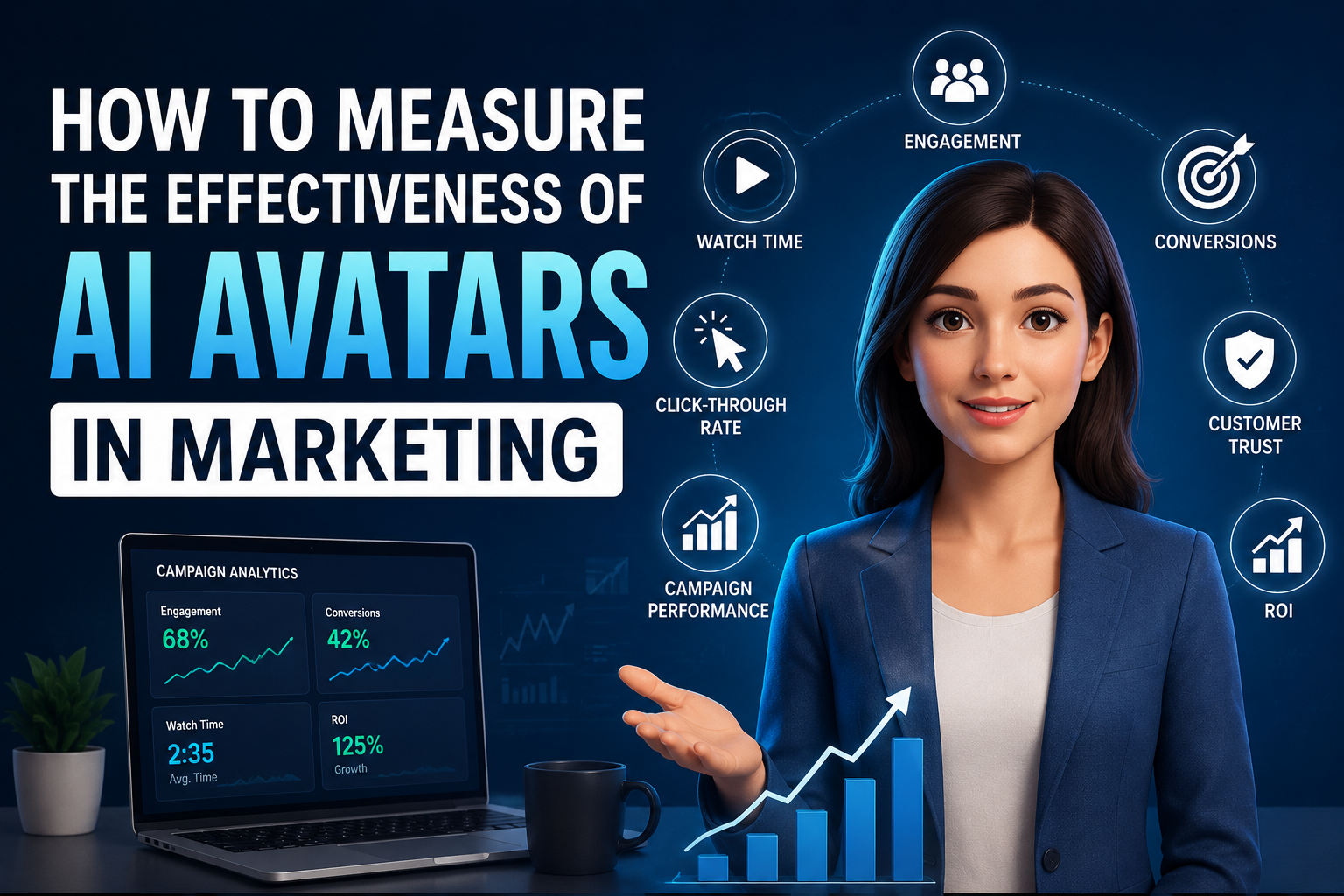
But using an AI avatar is not enough. You also need to know whether it is actually helping your business. To measure the effectiveness of AI avatars in marketing, you should track engagement, conversions, customer trust, watch time, lead quality, retention, cost savings, and return on investment.

Introduction

Marketing is changing fast, and AI avatars are now becoming a strong part of online campaigns. Businesses use them to create videos, explain products, answer customer questions, and make content more engaging.

However, the real value of an AI avatar is not just how modern it looks. The real value comes from results. If your AI avatar is not improving engagement, sales, leads, or customer experience, then it may not be helping your marketing goals.

This guide explains how to measure the effectiveness of AI avatars in marketing using simple and practical methods. You will learn which metrics matter, how to track results, and how to improve your AI avatar campaigns.

What Are AI Avatars in Marketing?

AI avatars are digital characters created with artificial intelligence. They can look like real people, animated characters, brand representatives, virtual influencers, or talking assistants.

In marketing, AI avatars are used to communicate with customers in a more visual and interactive way. They can present a product, explain a service, answer questions, or appear in video ads and social media posts.

Common uses of AI avatars include:

  • Product explanation videos
  • Social media marketing videos
  • Website welcome messages
  • Customer support assistants
  • Training and onboarding content
  • Virtual influencers
  • Personalized marketing messages
  • E-commerce product guides

For example, an online clothing brand can use an AI avatar to explain size, fabric, styling tips, and offers. A software company can use an AI avatar to explain product features in a short video.

Why Measuring AI Avatar Performance Matters

Many businesses start using AI avatars because they look attractive and modern. But without proper measurement, you cannot know whether the avatar is helping your campaign or just adding decoration.

Measuring AI avatar performance helps you understand what is working and what needs improvement. It also helps you decide whether your investment in AI avatar tools is worth it.

You should measure AI avatar performance because it helps you know:

  • Whether people are watching your avatar content
  • Whether users are clicking your links
  • Whether the avatar is increasing conversions
  • Whether customers trust the avatar
  • Whether your campaign cost is decreasing
  • Whether the avatar is improving brand awareness
  • Whether the avatar is better than normal content

A good AI avatar should support your marketing goal. It should not only look good but also help customers understand your offer and take action.

Set a Clear Goal First

Before measuring anything, you need to set a clear goal. Without a goal, you may track the wrong numbers.

For example, if your goal is brand awareness, then views, reach, impressions, and shares are important. But if your goal is sales, then conversion rate, revenue, and cost per acquisition matter more.

Common AI avatar marketing goals include:

  • Increase website engagement
  • Generate more leads
  • Increase product sales
  • Improve customer support
  • Reduce video production cost
  • Improve brand recall
  • Increase social media reach
  • Explain products clearly
  • Improve customer trust

Once your goal is clear, it becomes easier to choose the right metrics.

Key Metrics to Measure AI Avatar Effectiveness

To measure the effectiveness of AI avatars in marketing, you need to look at different metrics together. One number is not enough.

For example, a video may get many views but no sales. Another avatar campaign may get fewer views but bring high-quality leads. That is why you should measure both engagement and business results.

The most important metrics are:

MetricWhat It MeasuresWhy It Matters
Engagement rateLikes, comments, shares, clicksShows audience interest
Watch timeHow long people watchShows content quality
Conversion rateActions taken by usersShows business impact
CTRClicks from views or impressionsShows message strength
ROIProfit from campaignShows financial value
Customer feedbackTrust and satisfactionShows user experience
Lead qualityQuality of generated leadsShows sales potential

1. Engagement Rate

Engagement rate shows how people interact with your AI avatar content. If users like, comment, share, save, or click, it means your avatar is getting attention.

This is especially important for social media, video ads, and website content. A good AI avatar should make people stop, watch, and interact.

You can track engagement through:

  • Likes
  • Comments
  • Shares
  • Saves
  • Clicks
  • Reactions
  • Chat interactions
  • Time spent on page
  • Social media replies

If your AI avatar videos get more comments and shares than normal videos, it means the avatar is helping your content perform better.

2. Video Watch Time

Most AI avatars are used in video content, so watch time is very important. Watch time tells you how long people stay with your video.

If viewers leave after a few seconds, your avatar intro may not be strong. If people watch most of the video, it means your avatar is keeping them interested.

Important video metrics include:

  • 3-second views
  • Average watch time
  • 25% video completion
  • 50% video completion
  • 75% video completion
  • Full video completion rate

For example, if your normal product video has an average watch time of 20 seconds and your AI avatar video has 45 seconds, the avatar may be improving audience attention.

3. Click-Through Rate

Click-through rate, also called CTR, shows how many people clicked after seeing your AI avatar content.

This metric is useful for ads, landing pages, emails, social media posts, and website banners. A higher CTR means your message is convincing enough to make users take the next step.

Formula:

CTR = Total Clicks / Total Impressions × 100

For example, if your AI avatar ad gets 10,000 impressions and 500 clicks, your CTR is 5%.

A good AI avatar should guide users clearly and encourage them to click without sounding too robotic or forced.

4. Conversion Rate

Conversion rate is one of the most important metrics in marketing. It shows how many users completed your desired action.

A conversion can be:

  • Buying a product
  • Filling a contact form
  • Signing up for a newsletter
  • Booking a call
  • Downloading a guide
  • Starting a free trial
  • Clicking an affiliate link

Formula:

Conversion Rate = Total Conversions / Total Visitors × 100

If your landing page without an AI avatar converts at 3% and the page with an AI avatar converts at 5%, then the avatar is likely helping your campaign.

5. Return on Investment

Return on investment, or ROI, shows whether your AI avatar campaign is profitable. This is important because AI avatar tools, video editing, scripts, and ads may cost money.

Formula:

ROI = Revenue – Campaign Cost / Campaign Cost × 100

You should include all campaign costs such as:

  • AI avatar tool subscription
  • Script writing cost
  • Video editing cost
  • Ad budget
  • Landing page design
  • Voiceover or customization cost

If your AI avatar campaign brings more revenue than it costs, it is effective.

6. Cost Per Acquisition

Cost per acquisition, or CPA, tells you how much money you spend to get one customer.

Formula:

CPA = Total Campaign Cost / Total Customers Acquired

For example, if you spend $500 on an AI avatar campaign and get 25 customers, your CPA is $20.

If your normal ad campaign has a CPA of $30 and your AI avatar campaign has a CPA of $20, then the avatar campaign is performing better.

7. Lead Quality

Getting more leads is good, but getting quality leads is better. Sometimes AI avatar campaigns bring many leads, but those leads may not turn into customers.

That is why you should measure lead quality, not just lead quantity.

Track these lead quality metrics:

  • Qualified leads
  • Sales calls booked
  • Email replies
  • Demo requests
  • Lead-to-customer rate
  • Average deal size
  • Customer interest level

A good AI avatar should explain your offer clearly. This helps attract people who are actually interested in your product or service.

8. Customer Trust and Feedback

AI avatars should feel helpful, clear, and trustworthy. If people feel confused or uncomfortable, the avatar may damage your brand image.

Customer feedback helps you understand how users feel about the avatar.

You can ask questions like:

  • Was the AI avatar helpful?
  • Did the avatar explain the product clearly?
  • Did the avatar feel trustworthy?
  • Was the voice natural?
  • Would you interact with this avatar again?
  • Did the avatar make the content easier to understand?

You can collect feedback through surveys, comments, reviews, chat ratings, and customer support forms.

9. Website Behavior

If your AI avatar is used on a website, you should measure how visitors behave after seeing it.

Website behavior can show whether the avatar is helping users stay longer, click more, and understand your content better.

Important website metrics include:

  • Bounce rate
  • Time on page
  • Scroll depth
  • Button clicks
  • Form submissions
  • Product page visits
  • Cart additions
  • Checkout starts

For example, if people spend more time on a product page with an AI avatar, it means the avatar may be improving product understanding.

10. Social Media Performance

AI avatars are commonly used on TikTok, Instagram, YouTube Shorts, Facebook, and LinkedIn. For social media, you should track both reach and engagement.

Important social media metrics include:

  • Views
  • Reach
  • Impressions
  • Watch time
  • Shares
  • Comments
  • Saves
  • Profile visits
  • Follower growth
  • Link clicks

Also read the comments carefully. Comments can show whether people like the avatar, trust it, or find it strange.

11. Customer Support Impact

Some businesses use AI avatars as virtual assistants for customer support. In this case, the goal is not always direct sales. The goal may be to reduce support workload and improve customer experience.

You can measure support impact through:

  • Questions answered
  • Average response time
  • Customer satisfaction score
  • Human agent handoff rate
  • Support ticket reduction
  • Resolution rate
  • Repeat questions

If your AI avatar answers common questions and reduces support tickets, it is saving time and money.

12. Brand Awareness

Sometimes AI avatars are used to make a brand more memorable. In this case, you need to measure brand awareness.

Brand awareness is not always about instant sales. It is about how many people see, remember, and recognize your brand.

You can measure brand awareness through:

  • Impressions
  • Reach
  • Brand mentions
  • Direct website visits
  • Branded search volume
  • Social media followers
  • Share of voice
  • Video shares

If more people search your brand name after an AI avatar campaign, it is a good sign.

Use A/B Testing

A/B testing is one of the best ways to measure AI avatar effectiveness. It helps you compare avatar content with normal content.

You can create two versions:

Version A: Content without AI avatar
Version B: Content with AI avatar

Then compare the results.

You can test:

  • Landing pages
  • Product videos
  • Social media ads
  • Email campaigns
  • Website popups
  • Explainer videos
  • Sales pages

A/B testing helps you know whether the AI avatar is truly improving performance or not.

Simple Example of AI Avatar Measurement

Let’s say you run an online skincare brand. You create two product videos.

The first video shows only product images and text. The second video uses an AI avatar to explain the benefits, ingredients, and how to use the product.

After 14 days, you compare both videos.

MetricNormal VideoAI Avatar Video
Views10,00012,500
Average watch time18 seconds41 seconds
Clicks250620
Sales3075
Conversion rate2.5%4.8%

In this case, the AI avatar video performed better. It got more watch time, more clicks, and more sales.

Common Mistakes to Avoid

Many marketers make mistakes when measuring AI avatar campaigns. These mistakes can give wrong results.

Avoid these common mistakes:

  • Only tracking views
  • Ignoring conversions
  • Not doing A/B testing
  • Using the same avatar for every audience
  • Not checking customer feedback
  • Ignoring mobile performance
  • Using poor scripts
  • Making the avatar too robotic
  • Not tracking ROI
  • Comparing different campaigns unfairly

A campaign with many views is not always successful. Real success comes from useful engagement, better customer experience, and business growth.

Tips to Improve AI Avatar Marketing Results

If your AI avatar is not performing well, you do not always need to stop using it. Sometimes small improvements can make a big difference.

Use these tips:

  • Write a clear and natural script
  • Keep videos short and focused
  • Use a voice that matches your brand
  • Add a strong call to action
  • Test different avatar styles
  • Use simple language
  • Make the avatar helpful, not annoying
  • Place the avatar where users need guidance
  • Track performance every week
  • Improve based on real data

The goal is to make the avatar useful for the customer. When the avatar solves a problem or explains something clearly, it performs better.

Best Tools to Measure AI Avatar Campaigns

You can use different tools to track AI avatar performance. The right tool depends on where you are using the avatar.

Useful tools include:

  • Google Analytics
  • Google Search Console
  • Meta Ads Manager
  • TikTok Analytics
  • YouTube Analytics
  • LinkedIn Analytics
  • Hotjar
  • Microsoft Clarity
  • HubSpot
  • Shopify Analytics
  • Email marketing reports
  • CRM dashboards

These tools help you understand traffic, clicks, sales, user behavior, and customer actions.

Simple Framework to Measure AI Avatar Success

Here is a simple framework you can follow:

StepWhat to Do
Step 1Set your campaign goal
Step 2Choose the right AI avatar format
Step 3Select important metrics
Step 4Launch the campaign
Step 5Compare with non-avatar content
Step 6Collect customer feedback
Step 7Check conversions and ROI
Step 8Improve and test again

This framework helps you measure performance in a clear and simple way.

FAQs

What is the best way to measure AI avatar effectiveness?

The best way is to track engagement, watch time, conversion rate, customer feedback, lead quality, and ROI. These metrics show both audience interest and business results.

Can AI avatars increase sales?

Yes, AI avatars can increase sales if they explain products clearly, build trust, and guide users toward action. However, results depend on script quality, audience fit, and campaign strategy.

What metrics are most important for AI avatar videos?

The most important video metrics are watch time, completion rate, engagement rate, clicks, and conversions. These show whether people watch and take action.

Should I use A/B testing for AI avatar campaigns?

Yes, A/B testing is highly useful. It helps you compare content with and without AI avatars to see which version performs better.

How do I know if customers trust my AI avatar?

You can measure trust through surveys, comments, reviews, chat ratings, customer feedback, and repeat interactions. Positive feedback shows that users feel comfortable with the avatar.

Conclusion

AI avatars can be powerful marketing tools, but only when you measure them properly. They can help brands create better videos, explain products, improve customer support, increase engagement, and generate more leads.

To measure the effectiveness of AI avatars in marketing, focus on real performance metrics such as engagement rate, watch time, click-through rate, conversion rate, ROI, customer feedback, and lead quality.

The best approach is simple. Set a clear goal, test avatar content against normal content, track the right numbers, and improve based on data. When used correctly, AI avatars can become a valuable part of your marketing strategy.
Similar Posts

Leave a Reply

Your email address will not be published. Required fields are marked *