
Pabington: What It Really Means (Fact-Checked Guide)
Last fact-checked: October 21, 2026
The short answer
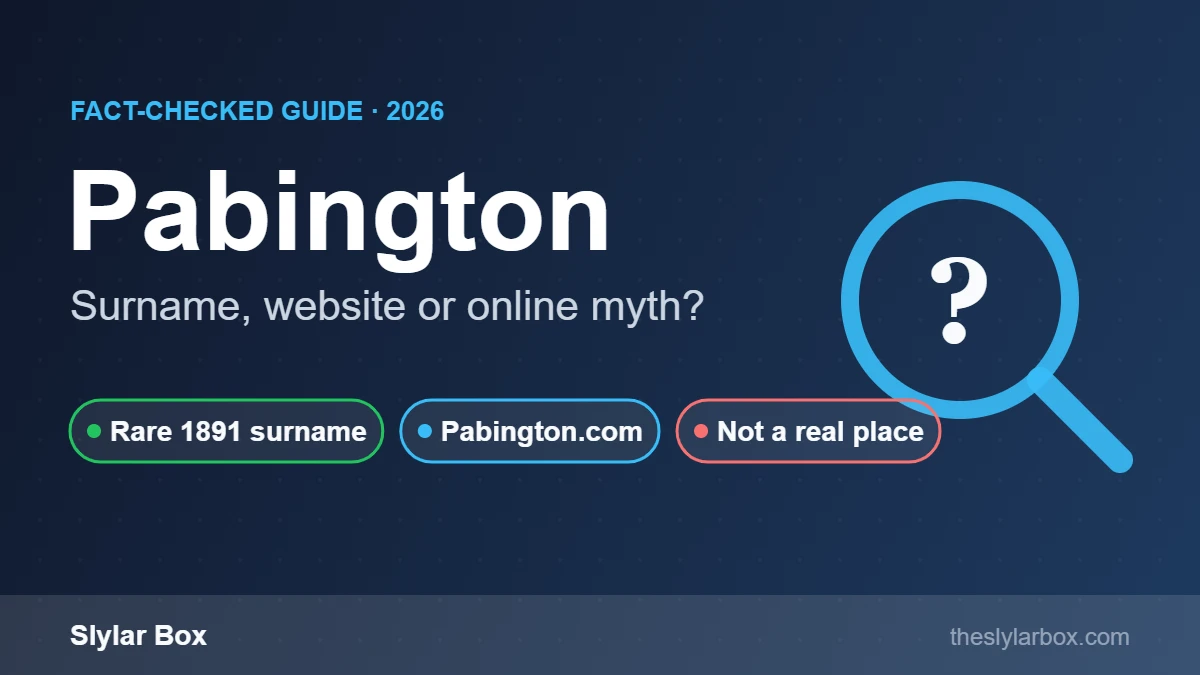
Pabington is not a real town or city. It has three documented uses: a very rare English surname (one family recorded in Kent in the 1891 UK census), the name of a content website, Pabington.com, and a name-like word used online for fictional places, usernames and brands. It has no dictionary definition.
Key facts at a glance
- Type of word: proper noun (a name), not a dictionary word
- Oldest verifiable record: 1891 UK census, one Pabington family in Kent (Ancestry)
- Total indexed records: 13 (10 birth, marriage and death records, 3 census and voter records)
- Real place? No verifiable town, village or postcode found
- Related to Paddington? No proven link; it only looks and sounds similar
- Modern use: website name (Pabington.com), fiction, usernames, brand ideas
What is Pabington?
Pabington is a rare proper name whose meaning depends on where you see it. When we researched it, only three uses could be backed by a record you can check yourself.
| Use | Evidence | How confident |
|---|---|---|
| Rare English surname | Ancestry family-history index, 1891 UK census | High |
| Website name | Pabington.com, an active news and lifestyle publication (Orbit News) | High |
| Fictional place, username or brand idea | Many blog posts and creative uses, no original source | Medium (usage exists, no fixed meaning) |
| Real village or town | No map, council or postcode record | Not supported |
Everything else you read about Pabington, such as “hidden gem villages”, local festivals or an ancient meaning, has no source behind it.
Pabington as a surname: the real evidence
The strongest historical trace of Pabington is genealogical. Ancestry’s surname index lists 13 records for the name: 10 birth, marriage and death records and 3 census or voter records (Ancestry).
Its census data shows one Pabington family living in Kent in 1891, which was every recorded Pabington in the UK that year. The same page also lists a 1940 US Federal Census record, which suggests at least one bearer of the name in the United States.
What this does and does not prove:
- It does prove the spelling existed long before the internet trend.
- It does not prove a village called Pabington existed. One family is too small a sample to trace a place of origin.
- It does not give the name a documented meaning. Ancestry’s page gives no meaning, and no published source we found explains one.
Tip for family researchers: rare names are often transcription variants. If you find “Pabington” in an old record, also search Babington, Pabbington and Paddington, because census clerks frequently misheard or misspelled names.
Is Pabington a real place?
No. None of the sources we reviewed lists a town, village, parish, postcode or landmark called Pabington. Some blogs describe Pabington as a countryside destination with cafés and festivals, but none give an address, coordinates or a local council.
You can check any place name yourself in under five minutes:
- Search the UK Ordnance Survey or Google Maps for the name.
- Look for a local council, parish or postcode.
- Check whether Wikipedia or a gazetteer lists it.
- Look for photos with a credited photographer and location.
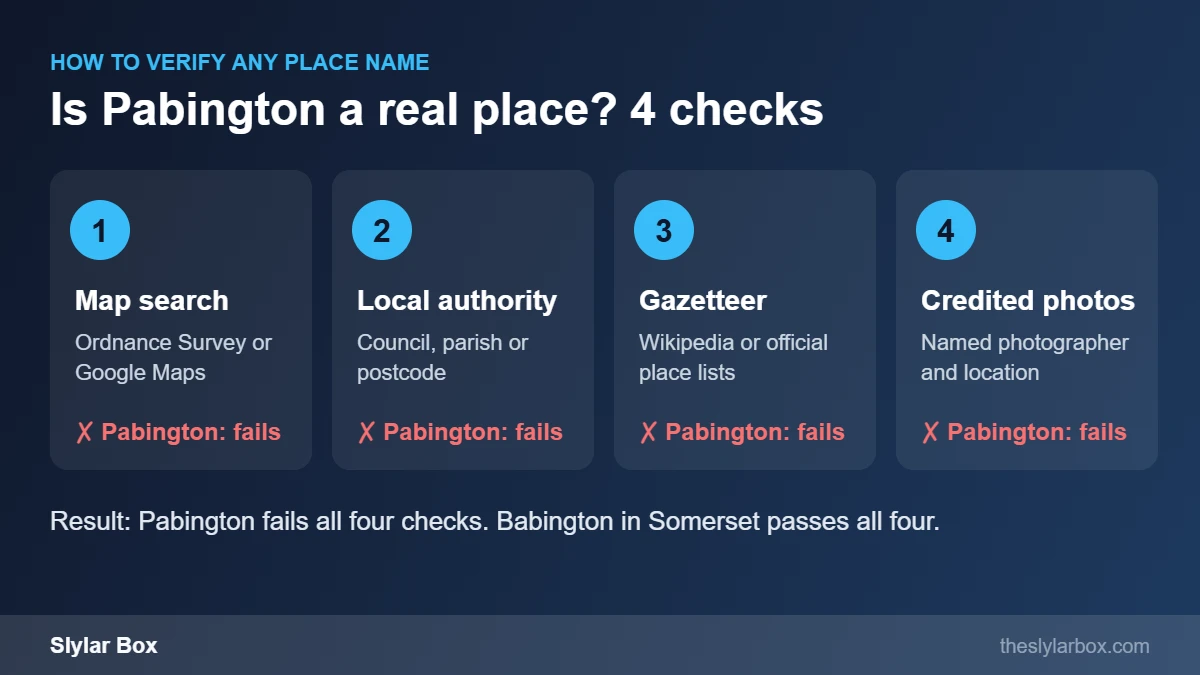
Pabington fails every step. A real place, like nearby-sounding Babington in Somerset, passes all four.
Pabington vs Paddington vs Babington
Much of the confusion comes from two real names that differ by one or two letters.
| Pabington | Paddington | Babington | |
|---|---|---|---|
| What it is | Rare surname, website name, online label | District of west London, railway station, famous fictional bear | Village in Somerset, England, and an established English surname |
| Real place? | No | Yes | Yes |
| Documented history | One family in 1891 census | Centuries of records | Medieval village; gentry family from the 13th century (Wikipedia) |
| Name origin | Unknown | Old English settlement name | Ba (personal name) + ing (people of) + ton (settlement) |
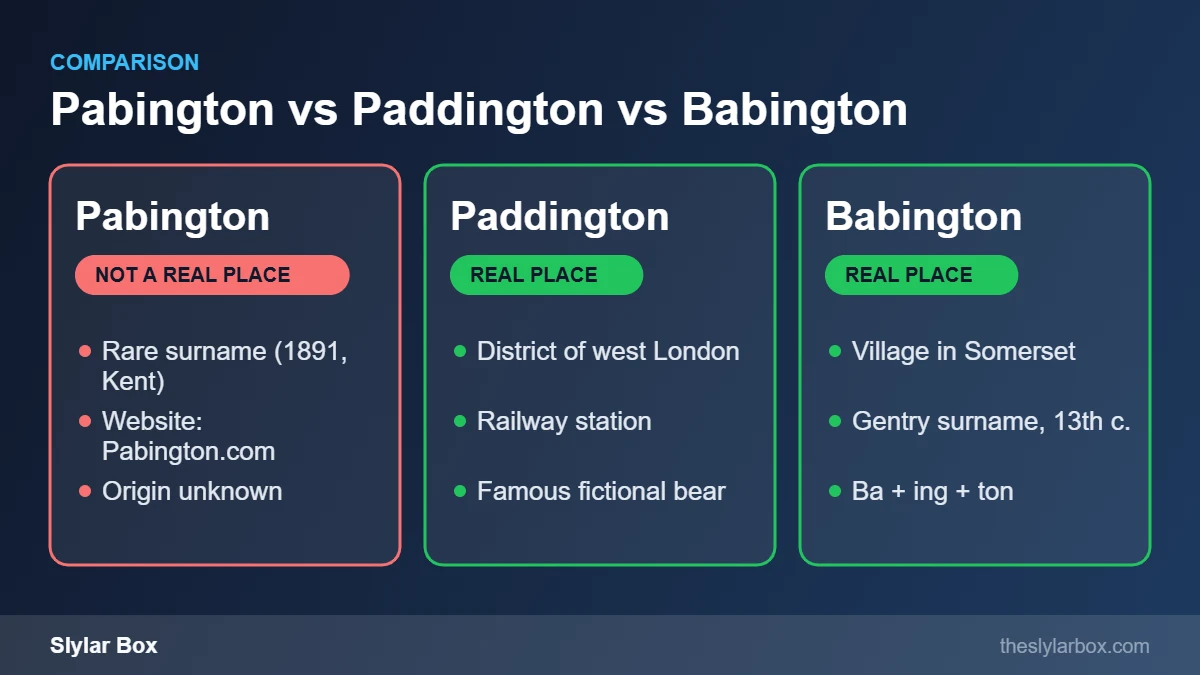
The Babington row matters most. Its documented structure, a personal name plus -ing plus -ton, is the pattern Pabington copies. That is why Pabington sounds historic, even though no record proves it is.
Where did the word Pabington come from?
No one has found a first use, so every origin story is a theory. Here is how much weight each deserves.
| Theory | What supports it | Confidence |
|---|---|---|
| A rare surname, possibly a variant of Babington | 1891 Kent census record; B and P are commonly swapped in old transcriptions | Moderate |
| An independent invented name (fiction, games, usernames) | The “-ington” pattern is easy to invent and sounds British | Moderate |
| A misspelling of Paddington that took on a life of its own | One letter apart; no first post has been found | Low |
| “The settlement of Paba’s people”, an ancient village | Looks like Babington’s structure, but no record of a person or place | Not supported |
If you see the last theory stated as fact, the writer has borrowed Babington’s etymology and applied it to a different word.
Fact check: what other Pabington articles get wrong
In October 2026 we reviewed the pages ranking for “Pabington” and compared each claim with the evidence above. Most agree it is not a real place. A notable minority invent history.
| Claim found online | Example page | Verdict |
|---|---|---|
| Families named Pabington “shaped local history” and descended from an original village | Rouute | False: no village or local history exists in any record |
| Pabington’s history “dates back to the early 1800s” and it is a “PBT model” for urban planning | Street63 | False: no source; the earliest record is 1891 |
| Pabington is “an old English name that most likely comes from a place name” | Newscora | Unproven: plausible pattern, zero evidence |
| Pabington represents “continuity, identity and community” | 3:AM Magazine | Opinion presented as meaning |
| Pabington is a rare surname, with one Kent family in 1891 | Finnorth, TBS News | True, matches Ancestry |
| Pabington is also the name of Pabington.com | Orbit News | True, but missed by most pages |
| Pabington is not a real place | PressVix, Fact News | True |
| Pabington started as a typo of Paddington | Several pages | Possible, but no first use has been found |
The lesson: when ten pages repeat the same claim, that is not ten sources. If none of them links to an original record, it is one guess copied ten times.
Why does Pabington keep trending?
Pabington is a textbook “mystery keyword”. It looks familiar enough that people expect an answer, but no authority has defined it. That gap creates a loop:
- Someone sees the word and searches it.
- Keyword tools show search volume, so publishers write about it.
- Each page fills the gap with its own interpretation.
- More pages make the word look established, so more people search.
Pabington is not the only example. Search phrases such as SEO by highsoftware99.com follow the same pattern: large search volumes, dozens of near-identical pages, and no verifiable company behind the name. Others lead somewhere real once checked: Nerwey, for example, is the name of two small websites.
Searchers also arrive with different intents: genealogists looking for the surname, readers who saw it on social media, writers wanting a fictional town name, and people looking for Pabington.com. A good answer has to serve all four.
How AI search answers “What is Pabington?”
This is where the topic matters for anyone working in SEO. AI Overviews, ChatGPT search and Perplexity build answers by summarising the pages they retrieve. With a mystery keyword, most of those pages copy each other, so AI answers can repeat an invented claim with confidence.
What that means for publishers and marketers:
- Lead with a direct, sourced answer. AI systems lift short, self-contained definitions. Our first paragraph is written to be quoted on its own.
- Link to primary records. A page that cites the Ancestry index gives AI systems something checkable, which is the strongest signal on a topic with no authority.
- Label uncertainty clearly. Confidence levels, like the tables above, help both readers and AI tell facts from theories.
- Add information nobody else has. Original comparisons, such as our fact-check table, are what earn citations when every other page says the same thing.
The takeaway for readers: if an AI answer tells you Pabington is a charming village, ask it for the source. It will not have one.
Can you use Pabington as a brand or username?
Possibly, with checks. The name is short, easy to say and has a gentle British tone, which suits a creative studio, newsletter, fictional setting or gaming handle.
Before using it commercially:
- Remember Pabington.com is already an active publication, so a media brand with this name may cause confusion.
- Search the USPTO and UK IPO trademark databases.
- Check domain availability and handles on the main social platforms.
- For fiction, make clear the place is invented, so readers do not mistake it for a real location.
Frequently asked questions
Pabington has no dictionary meaning. It is a rare English surname, the name of the website Pabington.com, and a name-like word people use for fictional places, usernames and brands.
No. No map, council, postcode or gazetteer lists a town or village called Pabington. Travel-style descriptions of it are invented.
Yes, but a very rare one. Ancestry indexes 13 records, including one family living in Kent in the 1891 UK census.
No. Paddington is a real district of London. Pabington only looks and sounds similar, and no link between them has been proven.
Its origin is unknown. The best-supported theory is a rare surname, possibly a spelling variant of Babington.
Pabington.com is an active online publication covering news, travel, lifestyle and sports. It is one of the main modern uses of the name.
The bottom line
Pabington is a real word with a thin paper trail: a handful of genealogy records, one modern website and a lot of online guesswork. Treat it as a rare surname or a name, not a place. When you meet a confident claim about its history, look for a link to an original record. If there is none, the claim is a theory.
Want to check another unfamiliar word? See all our mystery keyword fact-checks, including Wenrath, which turned out to be a real German village.
Sources
- Pabington surname records, Ancestry
- Babington family, Wikipedia
- Pabington: Meaning, Origin, Website, Orbit News
- Google Search spam policies
- Competitor pages reviewed are linked in the fact-check table above.






3 Comments