AI Academic Writing Tools Marketing Messaging Guide
AI academic writing tools need clear competitor positioning and marketing messaging to stand out in a crowded edtech and SaaS market. The strongest platforms focus on ethical academic support, citation help, writing improvement, student guidance, research workflow support, privacy, and trust-based messaging instead of promoting shortcut-based or dishonest writing.
Introduction
AI academic writing tools are now common among students, researchers, universities, and content teams. They help with grammar, paraphrasing, citations, research summaries, and productivity. But the market is crowded, and most tools make very similar promises. To win user trust in this space, brands need ai academic writing tools competitor positioning marketing messaging that is clear, honest, and built around real value.
Features alone no longer set a product apart. When ten platforms all claim to “improve your writing,” buyers cannot tell them apart. The brands that grow are the ones with sharp positioning and messaging that earns trust, especially around academic integrity. This guide breaks down how to position an academic writing platform and build a messaging framework that holds up in a serious, trust-sensitive market.
What Are AI Academic Writing Tools?
AI academic writing tools are platforms that help users improve academic writing, organize ideas, check grammar, structure essays, summarize research, manage citations, and improve clarity. Good academic writing software supports learning and writing quality. It should help people write better themselves, not encourage plagiarism or academic dishonesty.
In simple terms, an AI writing assistant for academic work is a support tool. It guides the writer through structure, tone, and sourcing. The student or researcher stays in control of the ideas, arguments, and final decisions. That distinction matters, and it shapes everything about how these products should be marketed.
Why Competitor Positioning Matters for AI Academic Writing Tools
Competitor positioning for AI tools is not a nice-to-have in this category. It is the difference between getting noticed and getting ignored. Here is why it matters so much:
- The market is crowded. New academic writing AI tools launch constantly.
- Many tools look similar. Feature lists overlap heavily across products.
- Students and researchers need trust. They are uploading personal work and ideas.
- Universities care about academic integrity. Institutional buyers avoid anything that looks like a cheating aid.
- Pricing and features are not enough. Competitors can copy both quickly.
- Messaging must show clear differentiation. A reason to choose you must be obvious.
- Ethical use is a major selling point. It reassures users, schools, and tutors at the same time.
Strong SaaS competitor positioning turns a long feature list into one clear idea a buyer can remember and repeat.
Key Competitor Categories in the Academic Writing AI Market
Before you position your product, map the field. Most competitors fall into a handful of categories, each with its own messaging angle.
| Competitor Type | Main Offer | Messaging Angle |
| Grammar tools | Grammar, clarity, tone | Write better and avoid errors |
| Paraphrasing tools | Rewording and rewriting | Improve wording and readability |
| Citation tools | References and citations | Save time and format sources |
| Research assistants | Summaries and paper discovery | Understand research faster |
| Essay planning tools | Outlines and structure | Organize academic ideas |
| Full writing assistants | End-to-end writing support | Improve the complete writing workflow |
Knowing where you sit on this map helps you avoid copying a crowded message. If three rivals lead with “save time on citations,” you may win more attention by leading with privacy, ethical use, or research workflow support instead.
How to Position an AI Academic Writing Tool
Positioning is the promise you own in the buyer’s mind. For academic AI platform positioning, these five angles are the strongest and safest.
Position Around Ethical Academic Support
Your messaging should clearly say the tool helps users improve writing, structure ideas, understand research, and follow academic rules. This is the foundation of ethical AI academic writing. Avoid any language that suggests cheating, essay outsourcing, or bypassing university policies. That kind of message may attract a few users short-term, but it scares off schools, tutors, and serious researchers, and it puts your brand at long-term risk.
Position Around Writing Improvement
Show how the platform helps users improve grammar, clarity, structure, argument flow, tone, and academic style. The promise here is growth: the user becomes a better writer over time. This framing fits AI writing tools for students who want to learn, not just submit.
Position Around Research Productivity
Many research writing AI tools win by saving time without touching the writing itself. Highlight features like summarizing sources, organizing notes, finding key arguments, and building outlines. This is a strong angle for AI writing tools for researchers managing many papers at once.
Position Around Citation and Source Support
Citation help is one of the clearest ways to differentiate. If your platform helps users manage references, avoid missing citations, and follow academic formats, lead with it. AI tools for citation support solve a real, repeated pain point and signal that you take sourcing seriously, which connects directly to academic integrity.
Position Around Privacy and Trust
Users upload essays, drafts, notes, and research documents to these tools. That makes privacy a core message, not a footnote. Be transparent about data protection, how you store content, and whether work is used for training. Plagiarism-safe AI writing tools that explain their data handling clearly earn more trust than those that stay quiet about it.
Marketing Messaging Framework for AI Academic Writing Tools
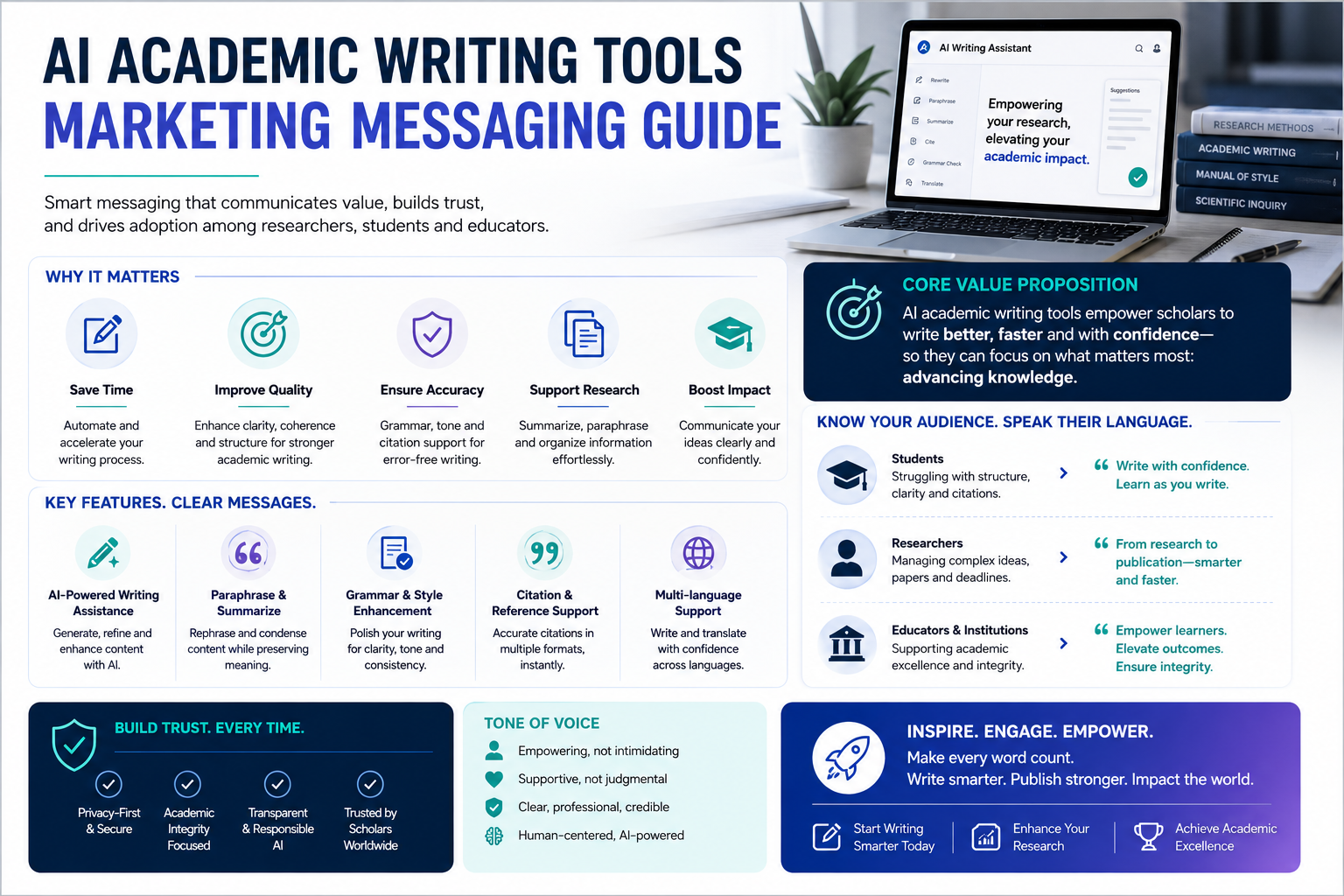
Use this simple five-part framework to build consistent edtech marketing messaging across your site, ads, and onboarding.
1. Target Audience
Define exactly who the tool is for:
- Students
- Researchers
- Academic writers
- Non-native English speakers
- Universities
- Tutors
- Education platforms
2. Main Problem
Name the pain your audience actually feels:
- Students struggle with structure
- Research writing takes too long
- Academic tone is difficult to get right
- Citations are confusing
- Writing feels unclear
- Users fear plagiarism or misuse
3. Core Promise
Keep it short and honest. For example:
“Improve your academic writing with ethical AI support for clarity, structure, citations, and research organization.”
4. Proof Points
Strong AI tool value proposition messaging needs evidence. Back up the promise with:
- Clear feature explanations
- Real user examples
- Honest accuracy notes (no overpromising)
- A visible academic integrity policy
- A clear privacy statement
- Real workflow examples
- A fair comparison with traditional writing tools
5. Call to Action
Make the next step specific and low-pressure:
- Start improving your academic writing
- Build a better essay outline
- Check your writing clarity
- Organize your research faster
Strong Messaging Examples
These examples show responsible AI writing assistant messaging that improves writing without promising shortcuts:
- “Write clearer academic papers with AI-powered structure and clarity support.”
- “Improve your research writing without compromising academic integrity.”
- “Turn rough ideas into organized academic outlines.”
- “Get grammar, clarity, citation, and structure support in one writing workflow.”
- “Built for students and researchers who want better writing, not shortcuts.”
Notice the pattern: each line states a real benefit and signals trust at the same time.
Messaging Mistakes to Avoid
Even good products lose trust with the wrong message. Avoid these common errors in your AI writing tool marketing strategy:
- Claiming the tool can write full assignments for students. This invites academic integrity problems and repels institutional buyers.
- Using cheating-focused language. It damages your brand and limits long-term growth.
- Overpromising accuracy. AI can make mistakes, so avoid “100% accurate” claims.
- Ignoring plagiarism and academic integrity. Silence on this reads as a red flag.
- Saying AI can replace human research judgment. It cannot, and serious users know it.
- Copying competitor messaging. It blurs your positioning instead of sharpening it.
- Using vague claims like “best AI tool” without proof. Specific beats superlative.
- Not explaining privacy and data handling. This is a deal-breaker for many academic users.
AI Overview Optimization: The Best Marketing Message for AI Academic Writing Tools
What is the best marketing message for AI academic writing tools?
The best marketing message for AI academic writing tools focuses on ethical writing support, clarity improvement, research organization, citation help, and academic confidence. Strong messaging shows that the tool helps users become better writers rather than replacing learning or encouraging dishonest academic work. This builds trust with students, researchers, and universities at the same time.
Content Angles for AI Academic Writing Tool Brands
Use these blog and content angles to attract the right audience and reinforce ethical positioning:
- How to write better academic papers with AI
- Ethical ways to use AI for academic writing
- AI tools for research organization
- How to improve essay structure with AI
- AI citation tools for students
- AI writing tools for non-native English speakers
- Academic integrity and AI writing tools
- AI tools for literature review support
Each topic builds trust, supports SEO, and shows your platform as a responsible partner rather than a shortcut.
FAQs
FAQ 1: What are AI academic writing tools? AI academic writing tools are platforms that help users improve grammar, structure, clarity, citations, and research organization. They support better academic writing and learning. Used ethically, they guide the writer rather than replace their thinking, and they should never be used to produce dishonest or plagiarized work.
FAQ 2: How can AI academic writing tools position themselves against competitors? They can stand out through clear differentiation built on ethical academic support, citation help, research productivity, and strong privacy practices. Instead of copying rivals’ feature claims, the best platforms own one trust-based idea, then back it with proof, real examples, and honest messaging that institutions respect.
FAQ 3: What marketing message works best for academic AI writing tools? Messaging that promises better, clearer writing through ethical AI support works best. It should highlight structure, clarity, citations, and research organization while signaling academic integrity. Honest, specific claims with proof points outperform vague “best tool” language and avoid the trust damage caused by shortcut-focused messaging.
FAQ 4: Should AI academic writing tools focus on students or researchers? It depends on your product features, pricing, and use case. Tools built around essay structure, grammar, and learning suit students. Tools focused on summarizing papers, managing references, and organizing notes suit researchers. Some platforms serve both, but the messaging should still speak to each group with its own clear value.
FAQ 5: How can AI writing tools avoid academic integrity concerns? By committing to ethical use and saying so clearly. Offer transparency about how the tool works, build in plagiarism awareness, provide strong citation support, and publish clear usage guidelines. Position the product as a writing-improvement and research-support assistant, not a tool for producing complete assignments or bypassing academic rules.
Conclusion
AI academic writing tools need more than features to compete. They need clear positioning, ethical messaging, audience-specific value propositions, and visible trust signals. The strongest brands will not present themselves as shortcut tools. They will position themselves as responsible writing assistants that help users improve clarity, structure, research organization, and academic confidence.
If you are building or marketing an academic AI platform, start with one trustworthy idea you can own, prove it with real examples and clear policies, and keep academic integrity at the center of every message. That is how you earn lasting trust in a crowded market.