How to Use AI for Email Marketing
Introduction
Email marketing is still one of the most powerful ways to connect with customers. Businesses use emails to share offers, promote products, build trust, and bring customers back to their websites.
But writing emails, managing lists, creating campaigns, and tracking results can take a lot of time. This is where AI can help.
AI makes email marketing faster, smarter, and more personalized. In this guide, you will learn how to use AI for email marketing in a simple and practical way.
What Is AI in Email Marketing?
AI in email marketing means using artificial intelligence tools to improve email campaigns. These tools can write content, analyze customer behavior, personalize messages, and automate email sequences.
AI can help marketers send the right message to the right person at the right time.
For example, if a customer leaves a product in the cart, AI can help send a reminder email with a product image, useful message, and special offer.
Why Use AI for Email Marketing?
AI helps email marketing become more effective. Instead of sending the same email to everyone, AI can help create better and more personalized messages.
AI can also save time by handling repeated tasks.
Main benefits include:
- Faster email writing
- Better subject lines
- Personalized content
- Smarter audience segmentation
- Automated follow-ups
- Better product recommendations
- Improved open rates
- Better click-through rates
- Clear performance insights
With AI, email marketing becomes easier to manage and more useful for customers.
How to Use AI for Email Marketing
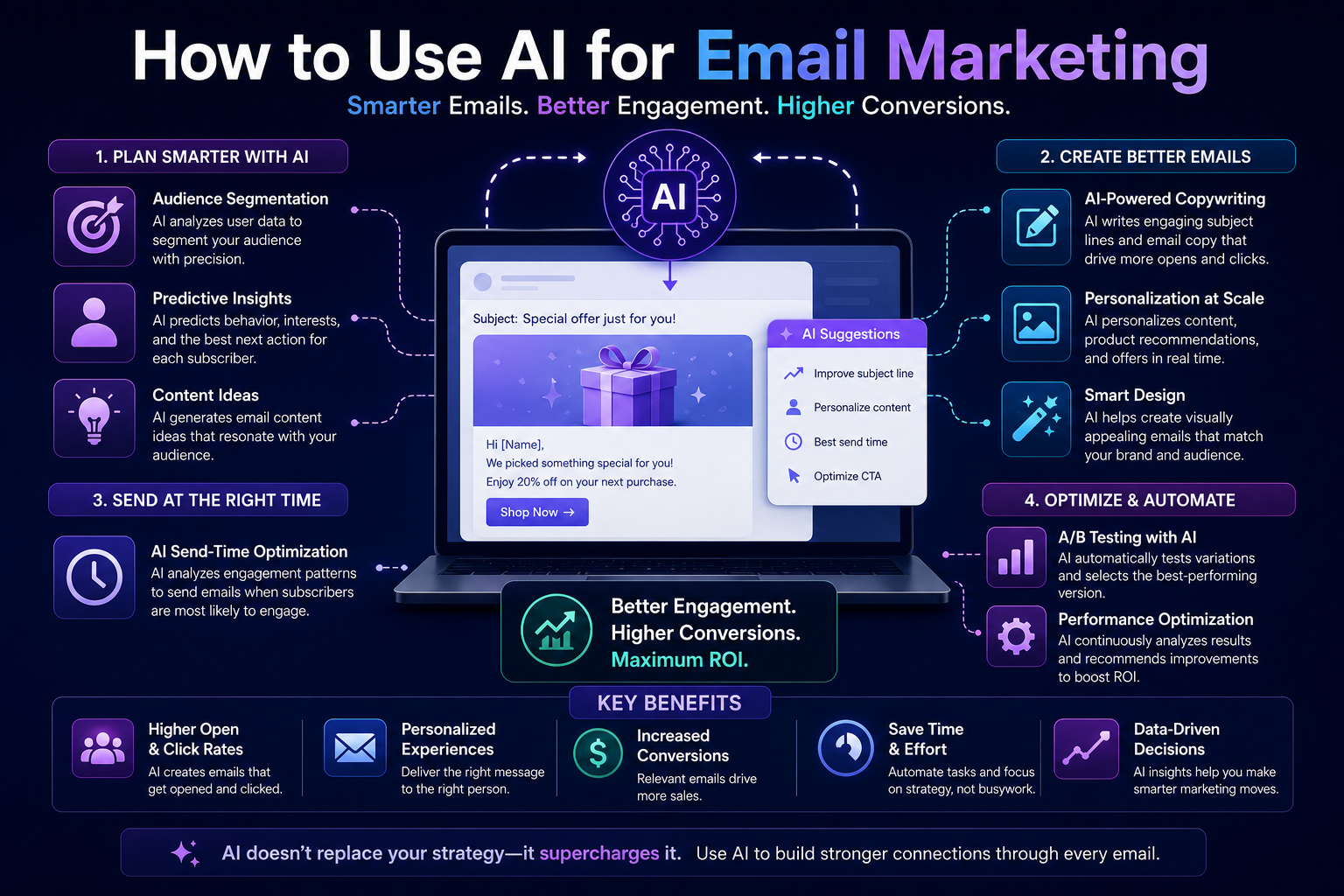
You can use AI in many parts of email marketing. From planning to writing, automation, testing, and reporting, AI can support almost every step.
Here is a simple overview:
| Email Marketing Area | How AI Helps |
|---|---|
| Subject lines | Creates catchy subject lines |
| Email content | Writes drafts and improves copy |
| Segmentation | Groups customers by behavior |
| Personalization | Sends relevant messages |
| Automation | Sends emails at the right time |
| A/B testing | Tests different email versions |
| Analytics | Tracks performance and gives insights |
1. Use AI to Write Better Subject Lines
The subject line is the first thing people see. If the subject line is weak, many people will not open your email.
AI can help create different subject line ideas based on your email goal.
For example, you can ask AI to write subject lines for:
- Product launch emails
- Discount offers
- Welcome emails
- Abandoned cart emails
- Newsletter emails
- Re-engagement emails
A good subject line should be clear, short, and interesting.
Example subject lines:
- Your special offer is waiting
- Don’t miss these new arrivals
- Complete your order today
- A quick update for you
- New tips to grow your business
2. Use AI to Create Email Content
AI can help write email drafts quickly. You can give AI your product, audience, offer, and tone, and it can create a useful email.
AI can write:
- Promotional emails
- Welcome emails
- Follow-up emails
- Newsletter emails
- Product update emails
- Customer thank-you emails
- Sales emails
- Event invitation emails
However, you should always edit AI-generated emails before sending. Add your brand tone, real details, and human touch.
3. Use AI for Audience Segmentation
Audience segmentation means dividing your email list into smaller groups. This helps you send more relevant emails.
AI can segment customers based on:
- Purchase history
- Website behavior
- Email engagement
- Location
- Interests
- Cart activity
- Product views
- Customer value
For example, a customer who bought skincare products may receive skincare tips, while a customer who viewed haircare products may receive haircare offers.
This makes emails more personal and effective.
4. Use AI for Personalization
Personalization means making emails feel more relevant to each person. AI can help personalize emails using customer data.
AI can personalize:
- Customer name
- Product recommendations
- Special offers
- Email content
- Send time
- Subject lines
- Website links
- Follow-up messages
For example, instead of sending “Check our products,” you can send “Here are products you may like based on your last visit.”
Personalized emails often perform better because they match customer interests.
5. Use AI for Email Automation
Email automation means emails are sent automatically based on customer actions.
AI can help create and improve automated email flows.
Common automated emails include:
- Welcome email series
- Abandoned cart emails
- Order confirmation emails
- Product recommendation emails
- Re-engagement emails
- Birthday emails
- Feedback request emails
- Post-purchase follow-ups
Automation saves time and keeps communication consistent.
6. Use AI for Abandoned Cart Emails
Abandoned cart emails are very useful for e-commerce businesses. These emails are sent when a customer adds a product to cart but does not complete the purchase.
AI can help write better abandoned cart emails with personalized product details and offers.
A good abandoned cart email may include:
- Product reminder
- Product image
- Simple message
- Discount offer
- Clear call to action
- Trust message
- Delivery or return information
AI can also help decide the best time to send the reminder.
7. Use AI for Product Recommendations
AI can recommend products based on customer behavior. This is useful for e-commerce email marketing.
AI can suggest products based on:
- Past purchases
- Browsing history
- Similar customer behavior
- Cart activity
- Wishlists
- Product categories
For example, if a customer buys a mobile phone, AI can recommend phone cases, chargers, or screen protectors.
Product recommendation emails can increase repeat sales.
8. Use AI to Improve Email Design
AI can also help improve email design ideas. While AI may not fully design your email inside every tool, it can suggest layout, sections, and content flow.
AI can suggest:
- Email structure
- Header text
- Call-to-action placement
- Product section ideas
- Button text
- Image suggestions
- Short paragraph style
A clean email design makes it easier for readers to understand your message and take action.
9. Use AI for A/B Testing
A/B testing means comparing two versions of an email to see which one performs better.
AI can help create different versions of:
- Subject lines
- Email headlines
- Call-to-action buttons
- Email copy
- Offers
- Product descriptions
- Send times
For example, you can test:
Version A: Get 20% Off Today
Version B: Your 20% Discount Is Waiting
Then you can check which subject line gets more opens.
10. Use AI to Choose the Best Send Time
Timing matters in email marketing. Sending emails at the wrong time can reduce open rates.
AI tools can analyze when your audience is most active and suggest the best time to send emails.
For example, some customers may open emails in the morning, while others may respond better in the evening.
AI can help send emails when each customer is more likely to open them.
11. Use AI for Email Analytics
AI can analyze email results and help you understand performance.
It can track:
- Open rate
- Click-through rate
- Conversion rate
- Unsubscribe rate
- Bounce rate
- Revenue
- Best-performing emails
- Weak subject lines
- Customer engagement
AI analytics helps you improve future emails instead of guessing.
12. Use AI to Re-Engage Inactive Subscribers
Some subscribers stop opening emails after some time. AI can help identify inactive subscribers and create re-engagement campaigns.
Re-engagement emails may include:
- Special offers
- Helpful content
- Product updates
- Feedback request
- “We miss you” message
- Preference update option
AI can help write these emails in a friendly way.
13. Use AI for Newsletter Ideas
Newsletters help you stay connected with your audience. But coming up with ideas every week can be difficult.
AI can suggest newsletter topics based on your industry, audience, and goals.
Newsletter ideas may include:
- Weekly tips
- Product updates
- Industry news
- Blog summaries
- Customer stories
- Special offers
- How-to guides
- Seasonal content
This helps you stay consistent with email marketing.
14. Use AI to Write Better Calls to Action
A call to action tells readers what to do next. It can be a button or a short line of text.
AI can help create stronger CTA ideas.
Examples include:
- Shop Now
- Get Your Free Guide
- Book a Call
- Claim Your Offer
- Read the Full Guide
- Start Your Free Trial
- Complete Your Order
- Explore New Arrivals
A clear CTA can improve clicks and conversions.
15. Use AI for Email List Cleaning
Email list quality is important. If your list has inactive or fake emails, your email performance can go down.
Some AI tools can help identify inactive users, invalid emails, and low-quality contacts.
Cleaning your email list can improve:
- Deliverability
- Open rates
- Sender reputation
- Campaign performance
- Email cost efficiency
It is better to have a smaller active list than a large inactive list.
Best AI Tools for Email Marketing
There are many tools that use AI features for email marketing.
Common options include:
| Tool | Best For |
|---|---|
| Mailchimp | Email automation and AI content |
| HubSpot | CRM and email marketing |
| Klaviyo | E-commerce email marketing |
| ActiveCampaign | Automation and segmentation |
| Brevo | Email and SMS marketing |
| Omnisend | E-commerce campaigns |
| ChatGPT | Email copy and ideas |
| Jasper | Marketing content writing |
Choose a tool based on your business size, budget, and campaign needs.
Simple AI Prompt for Email Marketing
You can use this prompt:
“Act as an email marketing expert. Write an email campaign for [product/service]. The target audience is [audience]. The goal is [sales/leads/awareness]. The tone should be [friendly/professional/simple]. Include a subject line, preview text, email body, and clear call to action.”
This prompt gives AI enough detail to create a useful email draft.
Example AI Email Campaign
Let’s say you are selling an online course. You can use AI to create a 3-email sequence.
| Purpose | |
|---|---|
| Email 1 | Introduce the course |
| Email 2 | Explain benefits and success stories |
| Email 3 | Share offer and call to action |
AI can write each email in a clear and persuasive way. Then you can edit the content and add real details.
Common Mistakes to Avoid
AI can help email marketing, but mistakes can reduce results.
Avoid these mistakes:
- Sending AI emails without editing
- Using generic subject lines
- Sending the same email to everyone
- Ignoring segmentation
- Using too many promotional emails
- Not testing subject lines
- Ignoring unsubscribe rates
- Not tracking results
- Making emails too long
- Forgetting mobile users
Good email marketing should feel helpful, not annoying.
Tips for Better AI Email Marketing
Use these tips to get better results:
- Keep emails simple
- Write clear subject lines
- Personalize where possible
- Use one main CTA
- Segment your audience
- Test different versions
- Track performance
- Edit AI drafts carefully
- Keep your brand voice natural
- Send useful content, not only offers
AI works best when combined with strategy and human editing.
FAQs
How can I use AI for email marketing?
You can use AI for subject lines, email content, personalization, segmentation, automation, A/B testing, product recommendations, and performance analysis.
Can AI write marketing emails?
Yes, AI can write marketing emails, but you should edit them before sending to make sure they sound natural and match your brand.
Is AI useful for email automation?
Yes, AI is very useful for automation. It can help create welcome sequences, abandoned cart emails, follow-ups, and re-engagement campaigns.
Can AI improve email open rates?
Yes, AI can help improve open rates by creating better subject lines, choosing better send times, and personalizing messages.
What is the best AI tool for email marketing?
The best tool depends on your needs. Mailchimp, Klaviyo, HubSpot, ActiveCampaign, Brevo, and ChatGPT are commonly used for AI email marketing.
Conclusion
AI can make email marketing faster, smarter, and more effective. It helps businesses create better subject lines, write email content, personalize messages, automate campaigns, recommend products, and analyze results.
To understand how to use AI for email marketing, start with simple tasks like subject lines, email drafts, and segmentation. Then move toward automation, personalization, and analytics.
The best results come when AI is combined with human editing, clear strategy, and helpful content. When used correctly, AI can improve email engagement, clicks, conversions, and customer relationships.