What Is an Artificial Intelligence Agent?
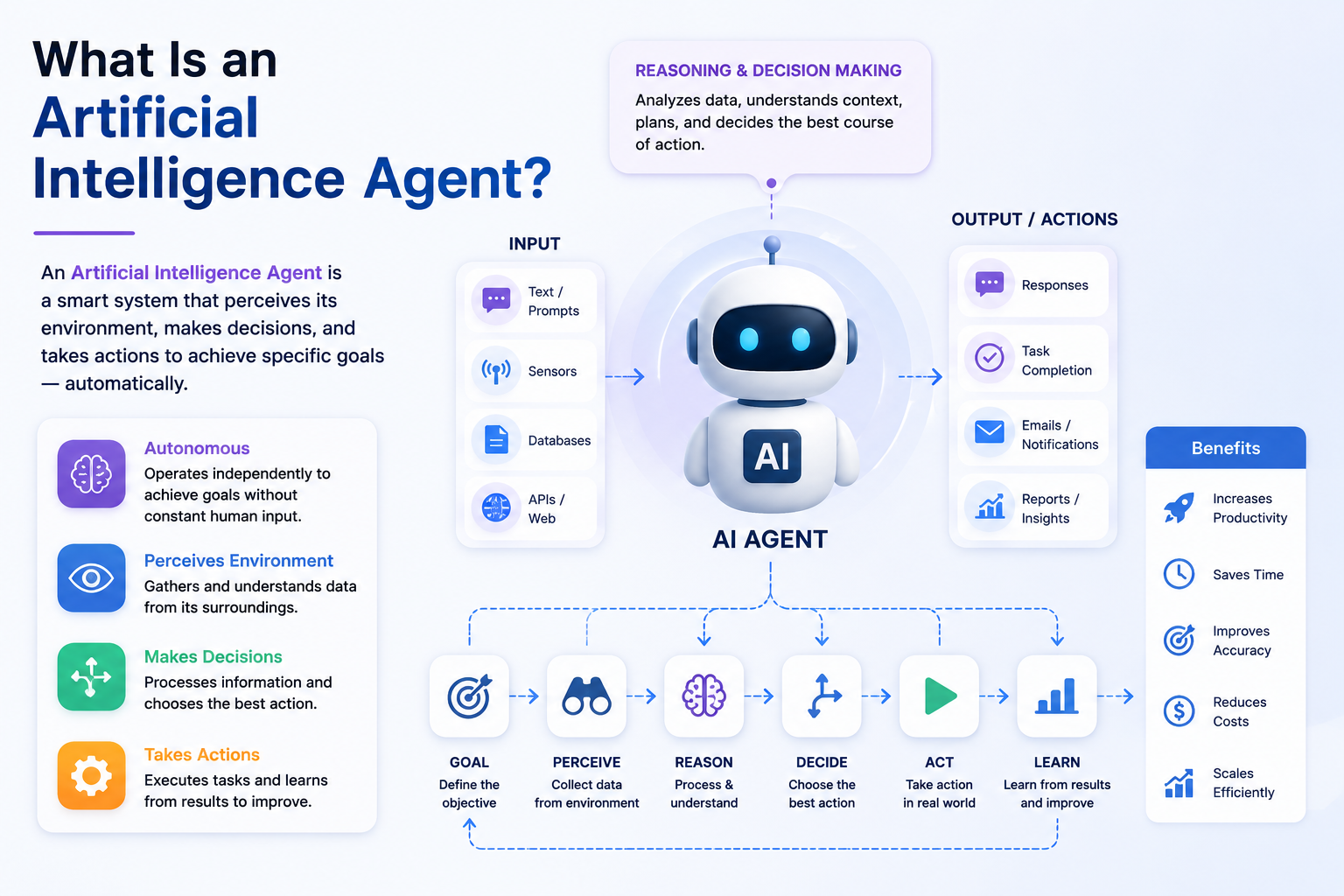
An artificial intelligence agent is a software system that perceives its environment and reasons about a goal and takes multi step actions to achieve that goal. It does this without needing a human to approve or direct every single step. That is what separates an AI agent from a chatbot. A chatbot simply responds to a prompt and stops. Here is the simplest test. Does it decide what to do next or does it wait for you to tell it? If it waits then it is a tool. If it decides then it is an agent.
AI Agent vs Chatbot vs Automation
These three get confused constantly but the distinction matters.
A chatbot responds to your message and stops. It depends on you to direct every exchange.
Rule based automation follows fixed rules. An example is a workflow that triggers when an email arrives and then creates a calendar event. It does not reason or adapt when something unexpected happens. See our guide on the best AI workflow automation tools for how platforms like Zapier and Make handle this kind of rule based automation.
An AI agent perceives and reasons and plans and acts in a continuous loop until the goal is complete. It adapts when something does not go as expected. It does not wait for a human to direct the next step.
How AI Agents Work
Most AI agents in 2026 run on a repeating loop. It is often described as perceive then reason then plan then act then observe.
Perceive : The agent gathers information from its environment. That could be emails or APIs or databases or a webpage.
Reason : It processes that information against its goal using an LLM as its reasoning engine.
Plan : It breaks the goal into smaller actionable steps.
Act : It executes a step using a tool. That could mean sending an email or calling an API or running code or browsing a page.
Observe : It checks the result and then feeds that back into the next round of the loop.
This loop is what allows an agent to handle tasks that are too complex or unpredictable for a single shot prompt. Anthropic has its own explanation of tool use and the Model Context Protocol. MCP is the open standard that lets agents connect to external tools without custom code for each integration. It is a useful technical reference here: Anthropic Model Context Protocol.
Core Components of an AI Agent
Autonomy : Proceeding through steps without requiring approval at each one.
Goal directed behavior : Working toward a specific objective rather than just responding.
Memory : Short term memory for the current task and long term memory for context across sessions.
Tool use : The ability to call APIs or run code or browse the web or query files.
Planning : Breaking a goal into a sequence of steps and adjusting the plan as new information comes in.
Types of AI Agents
Single task agents : These focus on one job such as a coding agent that reviews pull requests. They are the easiest to build and the most reliable in production. Most agent deployments in 2026 fall into this category.
Multi agent systems : Multiple specialized agents coordinate on parts of a larger task. One example is a writer agent working alongside an editor agent.
Human in the loop agents : These complete most of a workflow autonomously but pause for human approval at specific decision points. An example is drafting a contract but asking for approval before sending it. This is currently the most common deployment model for business use.
Real World AI Agent Examples
Coding agents : Tools like Claude Code and GitHub Copilot Workspace read a codebase and write implementations and run tests and return a pull request for review.
Customer support agents : These handle tier 1 queries such as product questions and returns and account issues autonomously. They escalate only complex cases to humans.
Financial agents : These monitor and rebalance investment portfolios based on live market conditions.
Research agents : These run literature reviews across large volumes of papers or documents and then summarize the findings.
If you have been following recent AI news then it is worth noting that a lot of what is driving the agent conversation traces back to models like Claude. See our piece on why Claude AI is trending for context on how these models are being positioned as the reasoning engine behind agentic systems.
Why AI Agents Matter for Business in 2026
The numbers show this is not a future trend. It is already mainstream. Gartner reports that around 80% of enterprise applications shipped or updated in Q1 2026 embed at least one AI agent. That is up from just 33% in 2024. The IBM overview of agentic architecture is a solid reference for how enterprises are structuring these deployments: IBM The 2026 Guide to AI Agents. Contact centers deploying autonomous agents report cost per contact reductions of 20 to 40%. Financial institutions report roughly 77% ROI on agent deployments. Median time to value across business functions is around 5.1 months.
Risks and Limitations
AI agents are not risk free. Key concerns include hallucinations and tool misuse and prompt injection. Cascading failures are another risk in multi agent setups where the mistake of one agent propagates to others. Good deployments enforce least privilege permissions and full action logging and human approval for high risk actions. They also include kill switches to halt an agent if something goes wrong. It is worth noting that governance has not kept pace with adoption. Only about 1 in 5 organizations report having mature governance in place for the agents they have deployed. That is the main reason human oversight remains standard practice even in otherwise autonomous systems.
Frequently Asked Questions
What is the difference between an AI agent and an AI assistant? An assistant helps you complete a task and it usually does so by responding to your requests. An agent can take independent action toward a goal without step by step instructions. The line is autonomy. Assistants support and agents act.
Is ChatGPT an AI agent? The standard chatbot version is not. It answers prompts and then waits. But the agent and deep research modes of ChatGPT do qualify. They browse the web and use tools and complete multi step tasks on their own before responding.
Do AI agents replace jobs? Mostly they automate repetitive and high volume work rather than eliminate entire roles. They shift human work toward supervising and directing agents rather than doing the repetitive task itself.
Is a Zapier workflow an AI agent? No. A workflow that triggers on a fixed rule is automation and not an agent. An example is a rule that creates a calendar event when an email arrives. It does not reason or adapt to unexpected situations the way an agent does.
Bottom Line
An artificial intelligence agent is defined by autonomy. It perceives and plans and acts toward a goal across multiple steps without waiting for a human to direct the next move. That is the line that separates it from a chatbot which waits for your next prompt. It is also what separates it from standard automation which follows fixed rules. In 2026 agents are already mainstream in business. Governance and oversight are still catching up to adoption. That is exactly why most serious deployments keep a human in the loop for anything high stakes.