How AI Is Changing Hiring and Recruiting
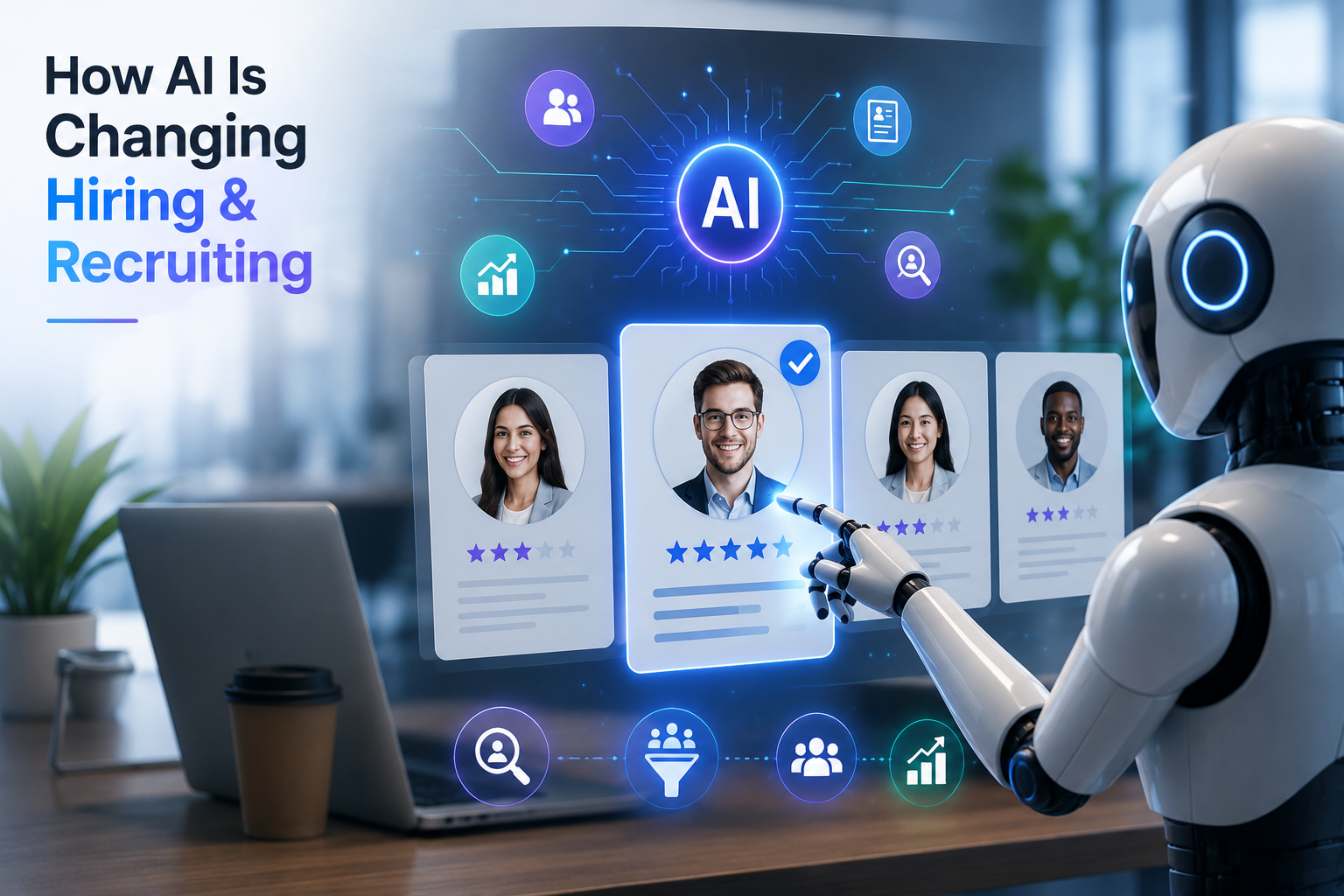
AI in hiring and recruiting has moved from experimental to mainstream in just a few years nearly 8 in 10 companies now use AI somewhere in their hiring process, and 99% of hiring managers report using AI in some capacity, according to Insight Global’s 2025 survey of talent acquisition executives. Most of this AI activity sits in the early, administrative stages: resume parsing, candidate ranking, and interview scheduling, while final hiring decisions overwhelmingly remain with humans. This guide breaks down exactly where AI now sits in the hiring pipeline, which tools dominate the market, the real bias risks behind the technology, and what both employers and job seekers need to understand in 2026.
What Is AI in Hiring and Recruiting?
AI in hiring and recruiting refers to software that uses machine learning and natural language processing to automate parts of the recruitment process parsing resumes, scoring candidates against a job description, ranking applicants, sourcing passive candidates, scheduling interviews, and in some cases analyzing video interview responses. It’s distinct from a traditional Applicant Tracking System (ATS) in one key way: a classic ATS matches keywords using rules-based logic, while the AI layer sitting on top of it summarizes resumes, scores candidates in plain language, and clusters similar applicants using an actual language model.
How AI Is Changing Hiring and Recruiting Today
The scale of adoption is the real story. Applicant Tracking Systems are now used by 97.8% of Fortune 500 companies, with Workday the most widely used platform among large enterprises. Beyond basic ATS parsing, 71% of hiring managers use some form of AI-driven screening, and 79% of companies have automated at least part of their hiring process. The volume problem is what’s driving this: the average job posting now receives around 258 applications, up from 208 just two years ago, and average time-to-fill sits at roughly 63.5 days numbers that make manual review alone impractical at scale.
Importantly, most hiring managers describe AI as a decision-support tool rather than a decision-maker. Roughly a third say AI ranks or recommends candidates while humans make all final calls, another fifth use AI purely for administrative support, and only a small minority allow AI to reject candidates with minimal human review. This human-in-the-loop pattern is consistent across nearly every major report on AI in hiring and recruiting published in 2026.
The AI Hiring and Recruiting Tool Landscape: Competitor Analysis
The market splits into a few distinct categories worth understanding before adopting any tool:
- Enterprise ATS platforms (Workday, Greenhouse, iCIMS, SmartRecruiters : the backbone layer at large companies, primarily parsing resumes and matching keywords, with AI features increasingly layered on top for summarization and ranking.
- Sourcing-and-screening hybrids (SeekOut, Eightfold AI, hireEZ, Phenom) : go beyond inbound applications to actively search hundreds of millions of public profiles and rank passive candidates by fit, then layer in inbound screening as well.
- SMB-focused AI screening (Manatal, Pin, Skima AI) : priced from roughly $15–49/month, these platforms are built for smaller recruiting teams that want AI screening without enterprise-level cost, often adding async video interviews and multi-channel outreach.
- Interview and assessment AI (HireVue, myInterview) : analyze video interview responses; this category has faced the most public scrutiny, with HireVue dropping facial-expression analysis from its core product in 2021 after disability-bias criticism.
For employers actively sourcing outside their own applicant pool including posting roles through job boards and using seek employer tools to reach a wider candidate base the sourcing-and-screening hybrid category is generally where AI adds the most measurable time savings, with some platforms reporting up to a 90% reduction in manual sourcing time.
Where AI Is Used in the Hiring and Recruiting Pipeline
A typical 2026 application moves through several AI-touched stages before a human recruiter opens the file:
- Parsing : the system extracts structured data (name, titles, dates, skills) from a resume, the same mechanism used by classic ATS platforms for decades.
- Knockout filtering : screening questions on work authorization, minimum experience, or location remove unqualified applicants before anyone reads the resume content still the single biggest cause of fast rejections, more than any AI “judgment” of resume quality.
- AI scoring and summarization : a language-model layer summarizes each resume, scores it against the role in plain language, and clusters similar candidates for the recruiter.
- Sourcing and outreach : for outbound recruiting, AI ranks passive candidates from large profile databases and can personalize outreach messages, which has been shown to increase positive candidate response rates by 5–12% over standard templated messages.
- Interview scheduling and, less commonly, video analysis : automated scheduling is now routine; AI analysis of video interview responses is used more selectively given the bias concerns below.
The Bias and Fairness Problem in AI Hiring and Recruiting
This is the part of AI in hiring and recruiting that deserves the most scrutiny. Independent research has found that resume-screening language models favored white-associated names over Black-associated names by a wide margin in blind testing, and speech-recognition components used in some AI interview tools showed error rates up to 22% higher for certain demographic groups errors that can translate directly into unfair screening outcomes. Candidate trust reflects this concern: only about 8% of job seekers believe AI hiring algorithms make the process fairer, and a large share of workers who’ve lost trust in hiring specifically blame AI.
The legal and regulatory response is catching up. The EEOC and Department of Justice issued joint guidance warning that algorithmic hiring tools can violate the Americans with Disabilities Act if they screen out qualified candidates with disabilities, even unintentionally. New York City’s Local Law 144 now requires companies to conduct yearly third-party bias audits on any automated tool used for hiring or promotion decisions, and a federal court has allowed a discrimination case against Workday to proceed on the theory that an ATS provider itself could bear liability for a discriminatory algorithm.
What Employers Should Know Before Adopting AI in Hiring and Recruiting
- Keep a human in the loop for final decisions this is both the current best practice and, increasingly, a legal safeguard given the ADA and bias-audit requirements now in effect in some jurisdictions.
- Audit for bias before and after deployment, not just at launch bias in these systems has been shown to persist even in tools marketed as fairness-tested.
- Don’t rely on AI video interview analysis without scrutiny this is the most bias-prone category, and several major employers have scaled it back or dropped it entirely.
- Expect regulatory scrutiny to increase, not decrease NYC’s audit law is likely a preview of broader requirements coming to other jurisdictions.
If your team is managing multiple AI hiring tools alongside broader recruiting workflows, it’s worth reading our guide on the best AI workflow automation tools, which covers platforms that can connect your ATS, calendar, and outreach tools without custom development. And if your hiring process includes autonomous scheduling or candidate triage, our explainer on what an AI agent actually is is useful context for understanding which “AI recruiting” features are genuinely autonomous versus simple rule-based automation with an AI label attached.
What Job Seekers Should Know About AI in Hiring and Recruiting
- Tailor every application : a targeted approach of 5–7 highly customized applications outperforms 50 generic ones by a wide margin in callback rate.
- Formatting matters as much as content : text-based PDFs and Word documents parse reliably; heavily designed resumes with graphics or complex columns often fail to parse correctly.
- Don’t try to “trick” the AI with hidden keywords : this is now actively detected by modern parsing systems and can flag an application as manipulative rather than helping it.
- Using AI to prepare is fine; using it to fully ghostwrite isn’t : hiring managers report meaningfully lower trust in applications they suspect were entirely AI-generated, while AI-assisted prep (mock interviews, editing) carries little downside.
If you’re building a job search workflow and considering delegating parts of it, our guide on how to hire a virtual assistant covers a similar principle from the other side of the hiring relationship knowing which repetitive tasks are worth automating or delegating, and which still need a human touch.
The Future of AI in Hiring and Recruiting
The clearest trend across every 2026 industry report is convergence toward a layered pipeline: classic ATS parsing at the base, an AI summarization and ranking layer on top, and human judgment reserved for the shortlist rather than the full applicant pool. Expect continued regulatory expansion following NYC’s audit law model, growing scrutiny of video-interview AI specifically, and increasing employer emphasis on demonstrated skills over keyword-matched resumes as AI-assisted applications become harder to differentiate on paper alone.
Frequently Asked Questions
Does AI reject most resumes automatically in 2026?
No this is one of the most persistent myths. Fast rejections are overwhelmingly caused by knockout screening questions (work authorization, experience, location) and resume parsing failures, not an AI judging resume quality. Only a small minority of hiring managers allow AI to reject candidates with minimal human review.
Is it safe to use ChatGPT to help with my resume or interview prep?
Using AI for editing and interview practice carries little downside and has been linked to better negotiation outcomes. Using AI to fully ghostwrite an application is riskier hiring managers report lower trust in resumes and cover letters they suspect were entirely AI-generated.
Can AI hiring tools discriminate against candidates?
Yes independent research has documented racial bias in resume screening and higher error rates for certain demographic groups in AI interview analysis tools, which is why regulators like the EEOC and NYC’s Local Law 144 now require oversight and bias audits for these systems.
What’s the difference between an ATS and AI hiring software?
A traditional ATS parses resumes and matches keywords using fixed rules. AI hiring software adds a language-model layer on top that summarizes, scores, and ranks candidates in plain language but in most 2026 pipelines, the ATS layer still does the bulk of the initial filtering.
Bottom Line
AI in hiring and recruiting has shifted from a novelty to standard infrastructure at nearly every large employer, but the technology remains firmly positioned as a decision-support layer rather than a replacement for human judgment and the bias risks documented across independent research mean that oversight, not blind adoption, is what separates responsible use from legal and reputational risk. For both employers and job seekers, understanding exactly where AI sits in the pipeline parsing, scoring, sourcing, or final decision is what actually determines how to navigate it well.