How AI Marketing Tools Support Multichannel Campaign Management
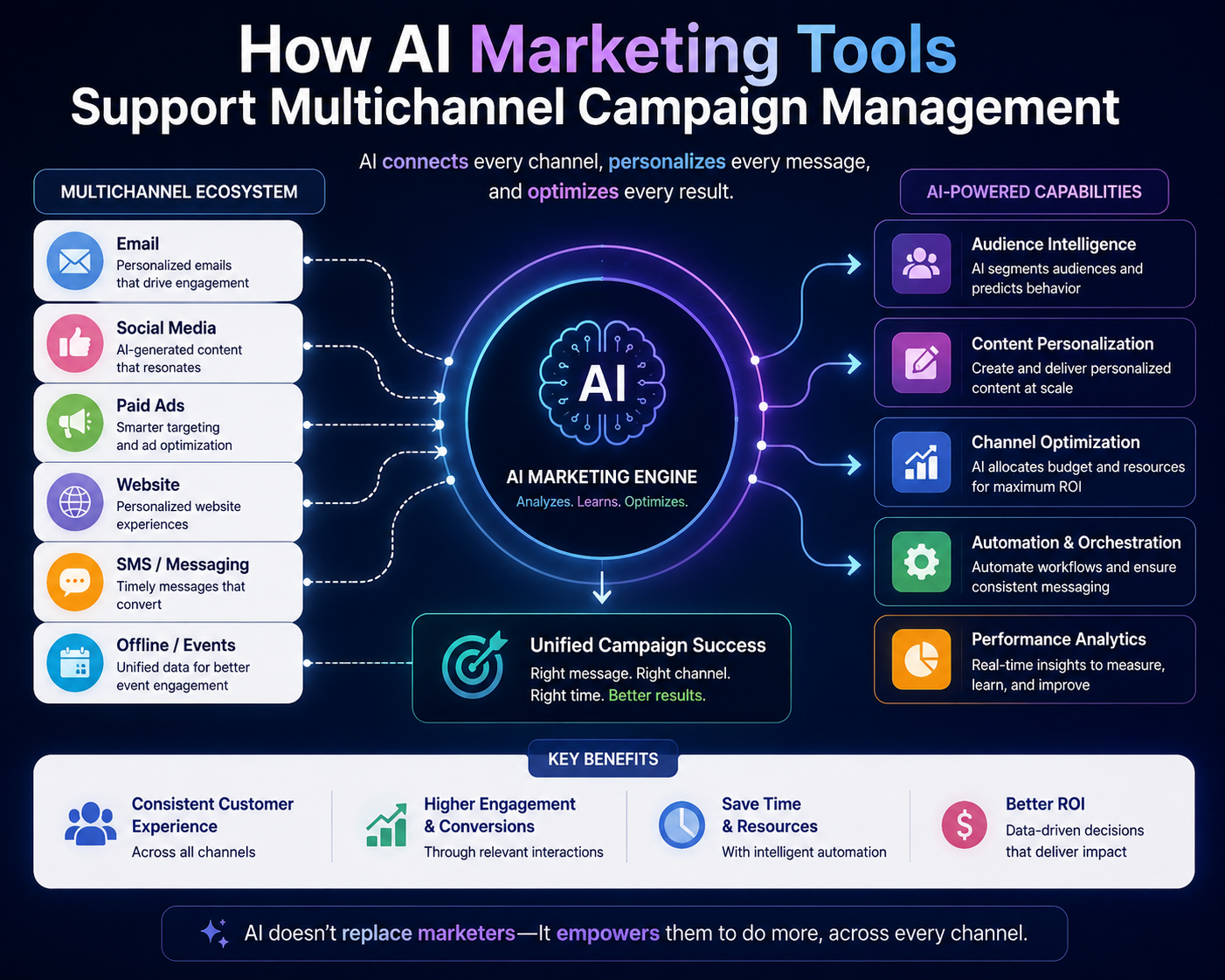
AI marketing tools support multichannel campaign management by helping businesses plan, create, automate, personalize, track, and optimize campaigns across different platforms like email, social media, websites, paid ads, and search engines.
Introduction
Modern marketing is not limited to one platform. Customers interact with brands through websites, emails, social media, search engines, ads, chatbots, and online stores.
Managing all these channels manually can be difficult. Marketers have to create content, schedule posts, run ads, send emails, track results, and improve campaigns at the same time.
This is where AI marketing tools can help. They make multichannel campaign management easier, faster, and more organized.
What Is Multichannel Campaign Management?
Multichannel campaign management means running and managing marketing campaigns across different platforms at the same time.
These platforms may include:
- Email marketing
- Social media
- Google Ads
- Facebook Ads
- TikTok
- YouTube
- Website content
- SEO
- SMS marketing
- Chatbots
- E-commerce platforms
The goal is to reach customers wherever they are and keep the message consistent across every channel.
What Are AI Marketing Tools?
AI marketing tools are software platforms that use artificial intelligence to improve marketing tasks. They can analyze data, automate work, create content, personalize messages, and track campaign performance.
These tools help marketers make better decisions and reduce manual work.
AI marketing tools can help with:
- Content creation
- Email automation
- Audience segmentation
- Ad optimization
- Customer support
- Campaign analytics
- Social media scheduling
- SEO planning
- Personalization
In simple words, AI tools help marketers manage campaigns more smartly.
Why AI Tools Matter for Multichannel Campaigns
Multichannel marketing can become confusing when many platforms are involved. Each channel has its own audience, content format, timing, and performance data.
AI tools help bring everything together. They can show what is working, where customers are engaging, and which channel is giving better results.
AI tools matter because they help marketers:
- Save time
- Keep campaigns consistent
- Understand customer behavior
- Personalize messages
- Improve targeting
- Track performance
- Reduce manual tasks
- Make faster decisions
This helps businesses run better campaigns with less stress.
How AI Marketing Tools Support Multichannel Campaign Management
AI marketing tools support multichannel campaign management in many ways. They help from planning to execution and performance improvement.
Here is a simple overview:
| Area | How AI Helps |
|---|---|
| Planning | Creates campaign ideas and timelines |
| Content | Generates posts, emails, ads, and copy |
| Automation | Schedules and manages repeated tasks |
| Personalization | Sends relevant messages to users |
| Analytics | Tracks campaign performance |
| Optimization | Improves ads, emails, and content |
| Reporting | Creates clear performance reports |
1. Campaign Planning
Every successful campaign starts with a clear plan. AI tools can help marketers create campaign strategies based on goals, audience, and platforms.
For example, if your goal is to launch a new product, AI can suggest content ideas for email, social media, ads, landing pages, and blog posts.
AI can help plan:
- Campaign goals
- Target audience
- Content calendar
- Channel strategy
- Posting schedule
- Ad ideas
- Email sequence
- Campaign timeline
This makes campaign planning faster and more structured.
2. Audience Segmentation
Audience segmentation means dividing customers into different groups based on behavior, interest, location, purchase history, or engagement.
AI tools can analyze customer data and create smarter segments.
For example, AI can identify:
- New visitors
- Repeat buyers
- Cart abandoners
- High-value customers
- Inactive subscribers
- Discount buyers
- Product viewers
- Loyal customers
This helps marketers send the right message to the right people on the right channel.
3. Personalized Messaging
Personalization is very important in multichannel marketing. Customers are more likely to respond when the message feels relevant.
AI marketing tools can personalize messages across email, ads, websites, and social media.
For example, one customer may receive a product recommendation email, while another may see a retargeting ad for a product they viewed earlier.
AI can personalize:
- Email subject lines
- Product recommendations
- Website banners
- Ad copy
- Chatbot messages
- SMS offers
- Landing page content
Personalization improves engagement and conversions.
4. Content Creation Across Channels
Different channels need different types of content. A blog post is not written like an Instagram caption. An email is not the same as a Google ad.
AI tools can help create content for each platform quickly.
AI can create:
- Blog outlines
- Social media captions
- Email content
- Ad copy
- Product descriptions
- Video scripts
- Landing page copy
- SMS messages
This helps marketers create more content in less time while keeping the campaign message consistent.
5. Social Media Campaign Management
Social media campaigns need regular posting, engagement, and performance tracking. AI tools can help manage social media more efficiently.
AI can help with:
- Post ideas
- Caption writing
- Hashtag suggestions
- Best posting times
- Content scheduling
- Engagement analysis
- Trend tracking
- Competitor research
For example, AI can show which posts get more engagement and suggest similar content for future campaigns.
6. Email Marketing Automation
Email is an important part of multichannel campaigns. AI tools can help create and automate email sequences.
AI can improve email marketing by:
- Writing subject lines
- Creating email content
- Personalizing offers
- Segmenting subscribers
- Choosing send times
- Creating follow-up emails
- Tracking open rates
- Tracking click rates
For example, if a customer signs up for a newsletter, AI can trigger a welcome email series automatically.
7. Paid Ads Optimization
Paid ads are used on platforms like Google, Facebook, Instagram, TikTok, and LinkedIn. Managing ads across multiple platforms can be difficult.
AI tools can help optimize ads by analyzing performance data.
AI can help with:
- Audience targeting
- Budget allocation
- Ad copy variations
- Creative testing
- Bid optimization
- Retargeting
- Conversion tracking
- Campaign reporting
If one ad performs better than another, AI can help move budget toward the stronger ad.
8. SEO and Content Strategy
SEO is another important channel in multichannel marketing. AI tools can help create SEO-friendly content that supports the campaign.
For example, if you are running a campaign for an AI marketing tool, you can also publish blog posts, guides, and FAQs around related keywords.
AI tools can help with:
- Keyword research
- Topic ideas
- Content outlines
- Search intent
- Meta titles
- Meta descriptions
- Content optimization
- Internal linking ideas
This helps bring organic traffic to your campaign.
9. Website Personalization
Your website is often the center of your campaign. AI tools can personalize website experiences based on visitor behavior.
For example, a returning visitor may see a special offer, while a new visitor may see an introduction message.
AI can personalize:
- Homepage banners
- Product recommendations
- Popups
- Landing page text
- Chatbot replies
- Offers
- Call-to-action buttons
A personalized website experience can improve conversions.
10. Chatbots and Customer Support
AI chatbots can support multichannel campaigns by answering customer questions instantly.
When customers come from ads, emails, or social media, they may have questions before buying. A chatbot can guide them quickly.
AI chatbots can help with:
- Product questions
- Pricing questions
- Order tracking
- Booking calls
- Lead collection
- FAQ answers
- Support requests
This improves customer experience and reduces pressure on support teams.
11. Campaign Performance Tracking
Tracking performance is very important in multichannel campaigns. Without tracking, you cannot know which channel is working best.
AI tools can collect data from different platforms and show clear insights.
They can track:
- Website traffic
- Email open rates
- Click-through rates
- Ad conversions
- Social engagement
- Sales
- Leads
- Customer behavior
- ROI
This helps marketers understand where to focus their efforts.
12. Better Reporting
Manual reporting can take a lot of time. AI tools can help create reports automatically.
A good report can show:
- Best-performing channels
- Weak campaigns
- Conversion rates
- Cost per lead
- Customer engagement
- Revenue
- ROI
- Suggested improvements
AI reporting saves time and helps teams make decisions faster.
13. Campaign Optimization
AI tools do not only track results. They can also suggest improvements.
For example, AI may suggest:
- Changing ad copy
- Testing a new subject line
- Posting at a better time
- Improving landing page text
- Targeting a different audience
- Reducing spend on weak ads
- Creating more content for a strong channel
This helps marketers improve campaigns while they are running.
14. Consistent Brand Messaging
In multichannel marketing, your brand message should stay consistent. If your email says one thing and your ad says something different, customers may feel confused.
AI tools can help keep content aligned with your brand voice.
You can guide AI with:
- Brand tone
- Target audience
- Product details
- Campaign goal
- Key benefits
- Words to use
- Words to avoid
This helps create a more professional and consistent campaign.
15. Customer Journey Management
A customer may see your ad, visit your website, read a blog, join your email list, and then buy later. AI tools can help track this journey.
Customer journey tracking helps you understand:
- Which channel brings awareness
- Which content builds interest
- Which message creates trust
- Which offer drives sales
- Where customers drop off
This helps marketers improve every stage of the journey.
Benefits of AI in Multichannel Campaign Management
AI offers many benefits for multichannel campaigns.
Main benefits include:
- Saves time
- Improves targeting
- Supports personalization
- Creates content faster
- Automates repeated tasks
- Improves ad performance
- Tracks results clearly
- Helps manage many channels
- Improves customer experience
- Supports better ROI
AI helps marketers work smarter across multiple platforms.
Common Challenges
AI tools are useful, but marketers should use them carefully.
Common challenges include:
- AI content may need editing
- Data privacy must be protected
- Too much automation can feel robotic
- Tools may be expensive
- Poor data can give poor results
- Brand voice may become inconsistent
- Human strategy is still needed
AI should support marketing teams, not replace their thinking.
Tips to Use AI Marketing Tools Effectively
To get better results, use AI tools with a clear strategy.
Useful tips include:
- Define your campaign goal
- Know your target audience
- Choose the right channels
- Keep brand voice consistent
- Use AI for automation and insights
- Edit AI-generated content
- Track performance regularly
- Test different versions
- Protect customer data
- Improve campaigns based on results
AI works best when combined with human creativity and strategy.
Example of AI Multichannel Campaign
Let’s say an online course business wants to launch a new course.
AI tools can help create:
- Blog post for SEO
- Facebook ad copy
- Instagram captions
- Email launch sequence
- Landing page text
- Chatbot answers
- Retargeting messages
- Campaign report
The same campaign message is shared across multiple channels, but each channel gets content in the right format.
This makes the campaign more organized and effective.
FAQs
How do AI marketing tools support multichannel campaign management?
AI marketing tools support multichannel campaign management by helping with planning, content creation, automation, personalization, performance tracking, and optimization across different platforms.
Can AI manage social media and email together?
Yes, many AI marketing tools can support both social media and email by creating content, scheduling posts, segmenting audiences, and tracking engagement.
Are AI marketing tools useful for small businesses?
Yes, AI tools are useful for small businesses because they save time, reduce manual work, and help manage campaigns with limited resources.
Can AI improve paid ad campaigns?
Yes, AI can improve paid ads by optimizing targeting, budget, copy, bidding, and performance tracking.
Do AI tools replace marketers?
No, AI tools do not replace marketers. They support marketers by handling repetitive tasks and providing insights, but human strategy and creativity are still important.
Conclusion
AI marketing tools are changing how businesses manage multichannel campaigns. They help marketers plan, create, automate, personalize, track, and optimize campaigns across many platforms.
To understand how AI marketing tools support multichannel campaign management, think of AI as a smart assistant that connects different marketing channels and improves performance.
The best results come when AI tools are used with clear goals, strong brand voice, human creativity, and regular performance tracking. When used correctly, AI can make multichannel marketing faster, smarter, and more effective.