What Is an Artificial Intelligence Agent?
Introduction
Artificial intelligence is becoming a big part of modern technology. From chatbots to automation tools, AI is now helping people and businesses complete tasks faster.
One important concept in AI is the artificial intelligence agent. Many people hear this term but do not fully understand what it means.
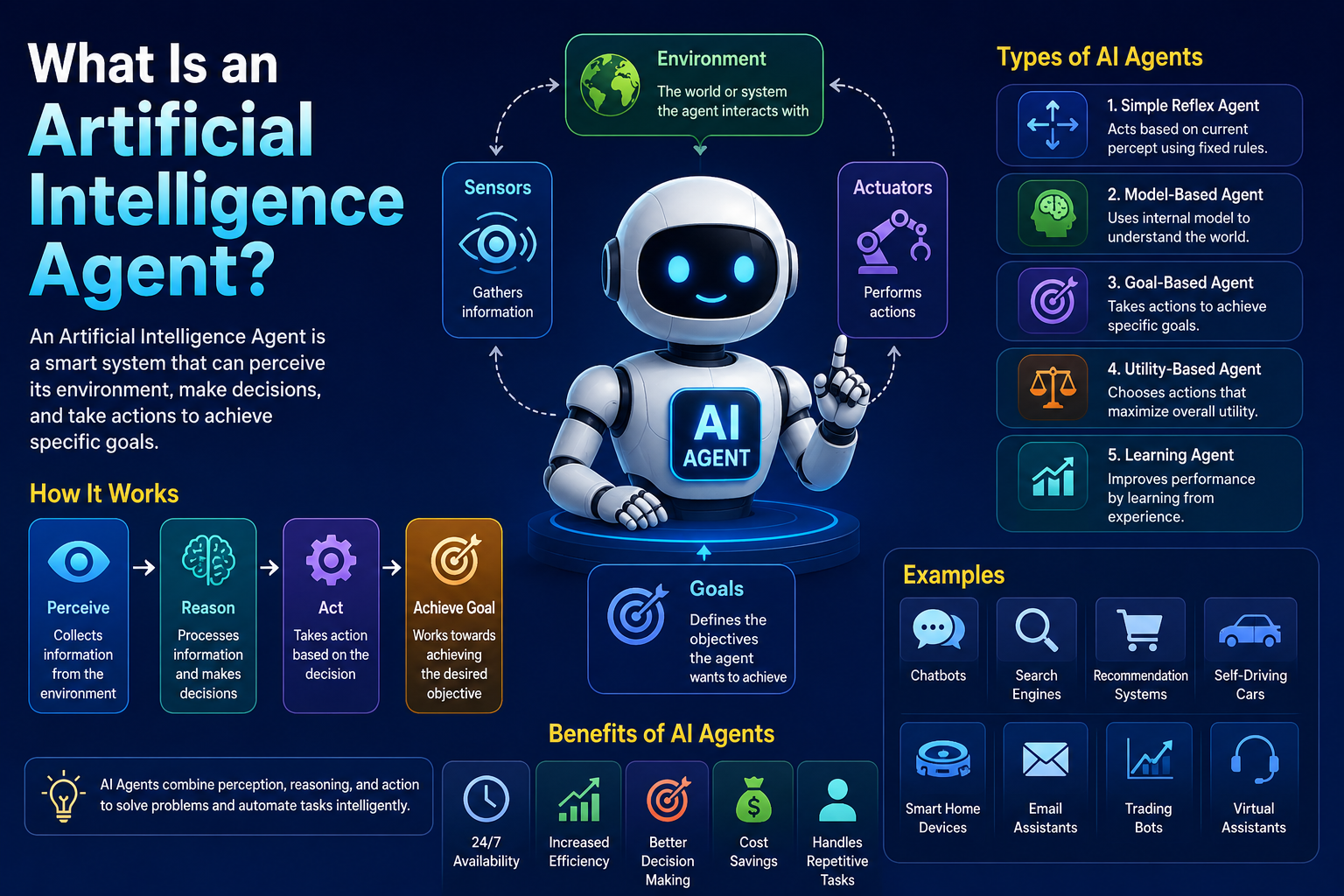
In simple words, an artificial intelligence agent is a system that can observe its environment, think about what to do, and take action to reach a goal. This guide explains what an AI agent is, how it works, and why it matters.
What Is an Artificial Intelligence Agent?
An artificial intelligence agent is a software system that can receive information, process it, make decisions, and perform actions.
It works like a digital assistant, but it can be more advanced depending on how it is built.
For example, an AI chatbot that answers customer questions is an AI agent. A recommendation system that suggests products is also an AI agent. A tool that checks data and sends automatic reports can also work like an AI agent.
The main idea is simple: an AI agent takes input, understands the situation, and gives an output or action.
How Does an AI Agent Work?
An AI agent usually works through three main steps.
| Step | What Happens |
|---|---|
| Input | The agent receives information |
| Processing | The agent analyzes the information |
| Action | The agent gives an answer or completes a task |
For example, if a customer asks, “Where is my order?” the AI agent receives the question, checks the order data, and gives the customer an answer.
This process may look simple, but advanced AI agents can handle complex tasks, make decisions, and learn from results.
Main Parts of an AI Agent
An AI agent usually has a few important parts.
These include:
- Sensors or input system: Collects information
- Knowledge base: Stores useful information
- Decision system: Decides what action to take
- Action system: Performs the task
- Learning system: Improves over time
For software agents, the input may be text, voice, data, or user behavior. The action may be sending a reply, creating content, updating a file, or triggering automation.
Types of Artificial Intelligence Agents
There are different types of AI agents. Some are simple, while others are more advanced.
1. Simple Reflex Agents
Simple reflex agents respond directly to current information. They follow basic rules.
For example, if a customer types “refund policy,” the agent shows the refund policy.
These agents are easy to build but cannot handle complex situations very well.
2. Model-Based Agents
Model-based agents understand more context. They do not only react to one input. They use stored information to understand the situation better.
For example, a support chatbot may check a customer’s order history before giving an answer.
This makes the response more useful and accurate.
3. Goal-Based Agents
Goal-based agents work to achieve a specific goal. They think about different actions and choose the one that helps reach the goal.
For example, an AI sales assistant may try to help a customer choose the best product and complete a purchase.
The goal is not just to answer questions but to guide the user toward a result.
4. Utility-Based Agents
Utility-based agents choose actions based on the best possible outcome. They compare different options and select the most useful one.
For example, a travel booking AI may compare price, distance, rating, and timing before suggesting the best hotel.
This type of agent is useful when there are many possible choices.
5. Learning Agents
Learning agents improve over time. They use feedback and data to get better at their tasks.
For example, an AI recommendation system learns what users like based on clicks, purchases, and behavior.
Over time, it gives better recommendations.
Examples of AI Agents
AI agents are already used in many tools and platforms.
Common examples include:
- Chatbots
- Virtual assistants
- Product recommendation systems
- AI writing assistants
- Customer support bots
- Email automation tools
- Fraud detection systems
- Smart home assistants
- Search engines
- AI sales assistants
For example, when Netflix recommends shows or Amazon suggests products, AI agents are helping personalize the experience.
AI Agent vs AI Tool
An AI tool usually helps with a specific task when a user gives a command. An AI agent can be more independent and may take steps toward a goal.
Here is a simple comparison:
| Feature | AI Tool | AI Agent |
|---|---|---|
| Works on command | Yes | Yes |
| Can make decisions | Limited | More advanced |
| Can complete workflows | Sometimes | Yes |
| Can use memory/context | Limited | Often yes |
| Can take multiple steps | Limited | Yes |
| Example | Text generator | AI customer support assistant |
In simple words, an AI tool helps you do a task, while an AI agent can manage a process.
Why AI Agents Are Important
AI agents are important because they help people and businesses save time. They can complete repeated tasks, answer questions, analyze data, and support decision-making.
Businesses use AI agents because they can:
- Work 24/7
- Reduce manual work
- Improve customer support
- Save time
- Handle many users
- Give faster responses
- Support automation
- Improve productivity
AI agents can make work easier when used correctly.
Benefits of Artificial Intelligence Agents
AI agents offer many benefits in business and daily work.
Main benefits include:
- Faster task completion
- Better customer service
- Lower workload
- More automation
- Improved personalization
- Better data analysis
- Consistent responses
- 24/7 availability
- Better productivity
For example, a support team can use an AI agent to answer common questions while human agents handle complex issues.
Uses of AI Agents in Marketing
AI agents are very useful in marketing. They can help marketers create, manage, and improve campaigns.
AI agents can support marketing by:
- Writing content drafts
- Creating social media captions
- Answering customer questions
- Sending email sequences
- Segmenting customers
- Analyzing campaign data
- Suggesting keywords
- Personalizing product recommendations
- Managing leads
This helps marketers save time and improve campaign performance.
Uses of AI Agents in Customer Support
Customer support is one of the most common uses of AI agents. They can answer basic questions instantly and guide customers.
AI support agents can help with:
- FAQs
- Order tracking
- Refund policies
- Product details
- Appointment booking
- Troubleshooting
- Ticket creation
- Live chat support
This improves customer experience and reduces pressure on human support teams.
Uses of AI Agents in Business
Businesses can use AI agents in many areas.
Examples include:
- Sales automation
- Data analysis
- Report generation
- HR support
- Customer service
- Inventory management
- Email automation
- Lead scoring
- Workflow automation
- Project management
AI agents are useful because they can handle repeated tasks and support better decisions.
AI Agents in Daily Life
AI agents are not only for businesses. People use them in daily life too.
Examples include:
- Voice assistants
- Smart home devices
- Navigation apps
- Recommendation apps
- AI writing tools
- Calendar assistants
- Translation tools
- Personal finance apps
When your phone suggests a route, reminds you of a meeting, or recommends content, an AI agent may be working behind the scenes.
How AI Agents Make Decisions
AI agents make decisions based on data, rules, models, and goals.
A simple AI agent may follow fixed rules. An advanced AI agent may use machine learning and context to decide what to do.
For example, an AI email assistant may decide which customers should receive a discount email based on past purchases and engagement.
The better the data and instructions, the better the decision.
Are AI Agents Always Accurate?
No, AI agents are not always accurate. They can make mistakes, misunderstand questions, or give wrong answers if the data is poor.
That is why human review is important, especially in sensitive areas like finance, health, legal work, and customer complaints.
Businesses should monitor AI agents and update them regularly.
Challenges of AI Agents
AI agents have many benefits, but they also have challenges.
Common challenges include:
- Incorrect answers
- Data privacy concerns
- Poor training data
- Bias in responses
- Over-automation
- Lack of human emotion
- Security risks
- Need for regular monitoring
AI agents should be used carefully and responsibly.
Tips for Using AI Agents Effectively
To use AI agents properly, follow these tips:
- Define a clear goal
- Use good quality data
- Give clear instructions
- Test before using publicly
- Monitor performance
- Keep human support available
- Protect customer data
- Update the agent regularly
- Review answers for accuracy
- Improve based on feedback
A good AI agent should help users, not confuse them.
Future of AI Agents
The future of AI agents is very strong. More businesses will use AI agents to automate work, improve customer service, manage campaigns, and support decision-making.
In the future, AI agents may become more advanced and able to handle longer workflows.
However, human control will still be important. AI agents can help with tasks, but humans should guide strategy, ethics, creativity, and final decisions.
FAQs
What is an artificial intelligence agent?
An artificial intelligence agent is a smart system that can receive information, make decisions, and take action to complete a goal.
What is an example of an AI agent?
Examples include chatbots, virtual assistants, product recommendation systems, AI customer support bots, and smart home assistants.
How does an AI agent work?
An AI agent works by receiving input, processing information, making a decision, and taking an action.
Are AI agents used in marketing?
Yes, AI agents are used in marketing for content creation, email automation, customer support, lead management, personalization, and analytics.
Can AI agents replace humans?
AI agents can automate some tasks, but they cannot fully replace humans. Human creativity, judgment, and emotional understanding are still important.
Conclusion
An artificial intelligence agent is a smart system that can understand information, make decisions, and take actions to complete tasks. AI agents are used in chatbots, marketing tools, customer support, recommendation systems, business automation, and daily life apps.
They help save time, improve productivity, and support better customer experiences. However, AI agents should be used carefully because they can make mistakes and need human monitoring.
When used correctly, AI agents can become powerful digital assistants for businesses, marketers, and everyday users.