Entrepreneurial Skills: The Complete Guide to What They Are & How to Build Them (2026)
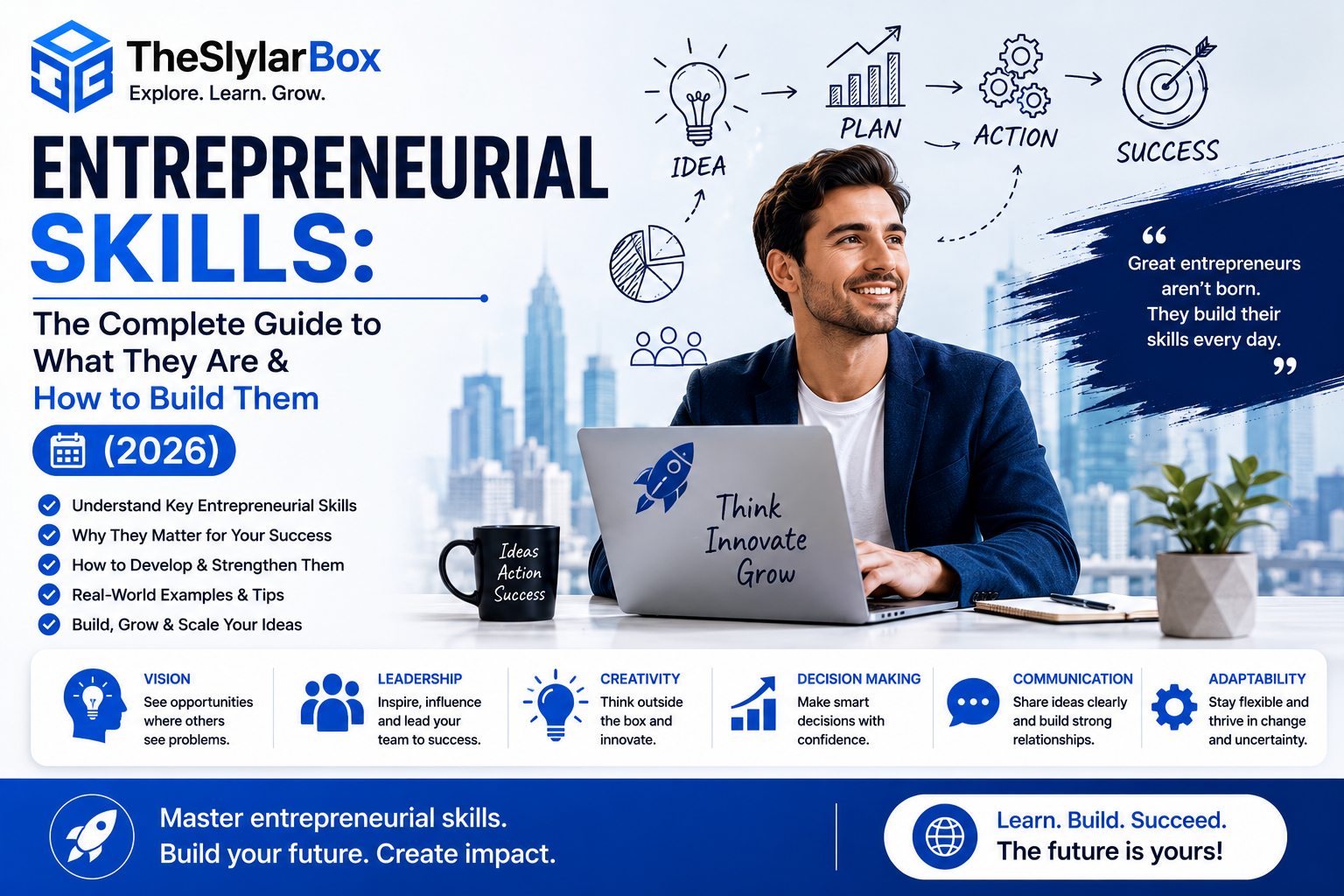
Entrepreneurial skills are the practical abilities that allow a person to spot opportunities, create value from limited resources, and build something sustainable out of uncertainty skills like opportunity recognition, financial literacy, sales, decision-making under pressure, resilience, and increasingly in 2026, the ability to leverage AI tools as a force multiplier. The reason entrepreneurial skills deserve your attention even if you never plan to found a startup is simple: they are the same skills that make people more valuable inside companies, more capable as freelancers, and more resilient in a job market that keeps changing under everyone’s feet.
In this guide, I will break down exactly what entrepreneurial skills are, the ten core skills that matter most (with what each one looks like in practice), the new AI-era skills that older lists ignore, the honest difference between skills you can learn and traits you are told you must be born with, and a practical development plan you can start this week — whether you are a student, an employee, or someone quietly building a side project.
What Are Entrepreneurial Skills? (Quick Answer)
Quick answer: Entrepreneurial skills are the learnable abilities needed to identify opportunities, take calculated risks, and turn ideas into viable ventures. They combine hard skills (financial literacy, marketing, sales, basic operations) with soft skills (communication, adaptability, leadership, resilience) and strategic skills (opportunity recognition, decision-making with incomplete information, resource management). Unlike a job-specific skillset, entrepreneurial skills are generalist by design: an entrepreneur must be functional across many areas rather than expert in one.
Two clarifications beginners find useful. First, these skills are not reserved for founders — employees who apply them inside organizations (often called intrapreneurs) are consistently among the most promoted people in any company. Second, and this matters: research and the lived experience of thousands of founders agree that these are overwhelmingly learned abilities, not birth gifts. We will return to that.
Why Entrepreneurial Skills Matter More in 2026
Three forces have pushed these skills from “nice for founders” to broadly essential:
- The barriers to starting have collapsed. Building a product, reaching customers, and handling operations once required teams and capital. Today, no-code tools, global marketplaces, and AI assistants let individuals do what small companies did a decade ago — but only for people with the skills to orchestrate these resources.
- Careers have become less linear. Freelancing, portfolio careers, and side businesses are mainstream. The skills of finding customers, pricing your work, and managing money are no longer optional for a growing share of workers.
- Companies now hire for it. Employers explicitly seek initiative, ownership thinking, and comfort with ambiguity — entrepreneurial skills wearing a corporate badge — because businesses that cannot adapt internally get outcompeted by those that can.
The 10 Essential Entrepreneurial Skills
Here are the core skills, with what each actually looks like in practice:
1. Opportunity Recognition
The foundational entrepreneurial skill: noticing problems worth solving before they are obvious. In practice this means listening for complaints (every recurring complaint is a business hypothesis), watching workarounds people create, and asking “why is this still annoying?” about everyday friction. It is trainable: people who deliberately log problems they encounter for a month are visibly better at spotting openings than those who don’t.
2. Sales and Persuasion
Every entrepreneur sells — to customers, investors, partners, and their first employees. Selling is not manipulation; it is clearly connecting a real problem to your solution and asking for commitment. It is also the most avoided skill among first-time founders, and that avoidance kills more ventures than bad products do. If you develop one uncomfortable skill from this list, make it this one.
3. Financial Literacy
You do not need accounting mastery; you need to fluently read the vital signs: revenue vs profit, margins, cash flow (the number-one killer of small businesses is running out of cash while “profitable on paper”), unit economics (what does one customer cost to acquire and what are they worth?), and burn rate. Every major business decision routes through these numbers.
4. Communication
Explaining an idea simply, writing clearly, listening well, and adjusting the message for the audience — a customer, a bank, a supplier, and a new hire each need the same truth told differently. Founders who communicate clearly raise money more easily, retain teams longer, and waste far less time on misalignment.
5. Decision-Making Under Uncertainty
Entrepreneurs almost never have complete information. The skill is making timely, reversible-where-possible decisions with maybe 70% of the data, and course-correcting fast — rather than waiting for a certainty that never arrives. A practical framework: classify decisions as reversible (decide fast, adjust later) or irreversible (slow down, gather more), and stop treating every choice like the second kind.
6. Adaptability and Learning Speed
Markets shift, platforms change rules, and first plans are usually wrong somewhere. The entrepreneurs who survive are rarely the smartest in the room; they are the fastest to update. This skill shows up as short feedback loops: ship small, measure, adjust, repeat — instead of perfecting in isolation for a year.
7. Leadership and Delegation
The transition that breaks many founders: from doing everything to building a system of people who do it better. Leadership at the entrepreneurial level means setting clear direction, delegating outcomes (not micromanaging tasks), giving honest feedback, and taking responsibility when things fail. Delegation is also a math skill: everything you refuse to hand off caps how large your venture can grow.
8. Time and Resource Management
Entrepreneurs manage scarcity by definition — limited money, limited hours, limited attention. The skill is ruthless prioritization: identifying the two or three activities that actually move the venture (usually product and customer acquisition) and defending them against the infinite busywork that feels productive but isn’t.
9. Networking and Relationship Building
Opportunities, first customers, hires, and rescue-moments overwhelmingly arrive through people. Effective networking is not collecting contacts; it is being consistently useful to others before you need anything, and maintaining genuine relationships across time. Introverts take note: this skill favors sincerity and follow-through over charisma.
10. Resilience and Stress Management
Rejection, failed launches, and financial pressure are structural features of building anything, not signs you are failing. Resilience is partly mindset (treating failures as data) and partly practical hygiene: financial buffers, exercise, sleep, and people you can be honest with. Burnout has ended more promising ventures than competition has — treat energy management as a business skill, because it is one.
The New Layer: AI-Era Entrepreneurial Skills (2026)
Here is what most traditional skill lists still miss: the leverage available to a single entrepreneur has exploded, and capturing it is now its own skill family.
- AI tool fluency: Knowing the current landscape well enough to route work correctly — drafting, research, analysis, design, and customer support all have capable AI assistance now. Entrepreneurs fluent with these tools operate with the output of a small team; those who ignore them compete against people who don’t.
- Prompt and delegation literacy: Working with AI is a management skill: specifying context, constraints, and desired output clearly, then critically reviewing what comes back. Notice that this is the same skill as delegating to people — clarity in, judgment on what comes out.
- Automation thinking: Habitually asking “does this recurring task need me?” and wiring together tools so that leads, invoices, reports, and follow-ups run themselves. Hours reclaimed from operations are hours reinvested in the two things that grow ventures: product and customers.
- AI-assisted validation: Market research, competitor analysis, and customer-persona drafts that took weeks now take days when AI does the assembly and the human does the judging. Faster validation means cheaper failures and quicker pivots — a direct upgrade to skill #6.
- Judgment as the differentiator: The counterweight to all of the above: as execution gets cheaper for everyone, taste, ethics, strategy, and knowing what to build become the scarce skills. AI raises the floor; human judgment still sets the ceiling.
Skills vs Traits: The Honest Conversation
The “born entrepreneur” myth deserves a direct answer, because it quietly discourages capable people. The evidence from decades of entrepreneurship education and thousands of founder journeys is consistent: while personality influences style (a bold risk-taker and a cautious analyst can both build great companies), every skill on the lists above is demonstrably learnable. Sales can be practiced. Financial literacy can be studied. Resilience measurably grows with experience and support systems. Opportunity recognition improves with deliberate exposure.
What is true: these skills are learned by doing, not by reading alone. Which is exactly why the development plan below is built around action.
How to Develop Entrepreneurial Skills (Practical Plan)
A realistic path that costs little and starts this week:
- Start a micro-venture within 30 days. Sell anything small — a service on a freelance platform, a digital product, flipping items online. Scale is irrelevant; the point is that one real customer teaches more than ten courses. Every skill above gets exercised at miniature scale.
- Practice sales deliberately. Set a tiny target: pitch your micro-venture to five real potential customers this month. Track what objections you hear — objections are free market research.
- Adopt one financial habit. Track your venture’s (or your personal) cash flow weekly in a simple sheet. Fluency comes from repetition, not textbooks.
- Build feedback loops. Ship something small every week and ask one user what was confusing. This trains adaptability and communication simultaneously.
- Use AI as your first employee. Route your research, drafts, and repetitive tasks through AI tools and practice reviewing the output critically — building the AI-era skill stack while saving the hours a solo operator doesn’t have.
- Invest in relationships weekly. One genuine, useful interaction per week — helping someone, sharing something relevant, following up — compounds into a real network within a year.
- Do a monthly review. One page: what worked, what failed, what you’ll change. This single habit converts experience into skill instead of just scar tissue.
For students specifically: campus clubs, competitions, and small campus services are low-risk laboratories for every one of these — and “built and sold X as a student” outperforms most CV lines in hiring conversations.
Frequently Asked Questions About Entrepreneurial Skills
What are the most important entrepreneurial skills?
The consistently critical ones are opportunity recognition, sales, financial literacy, communication, decision-making under uncertainty, adaptability, leadership, resource management, networking, and resilience — with AI tool fluency now joining the list as a genuine force multiplier for solo founders and small teams.
Can entrepreneurial skills be learned?
Yes — decisively. Personality shapes entrepreneurial style, but every core skill (selling, financial literacy, decision-making, resilience) is demonstrably learnable, primarily through doing: small ventures, deliberate practice, and structured reflection build these skills faster than passive study.
Why are entrepreneurial skills important for students?
They translate directly into employability (initiative, communication, and ownership are top hiring criteria), create income options beyond traditional jobs, and are cheapest to practice as a student, when small experiments carry minimal risk and campus environments offer ready-made testing grounds.
What is the difference between entrepreneurial skills and business skills?
Business skills (accounting, operations, management) run an existing organization efficiently. Entrepreneurial skills create something from nothing under uncertainty — spotting opportunities, validating ideas, and acting without complete information. Founders need both families, but the entrepreneurial set comes first chronologically.
How is AI changing entrepreneurial skills?
AI has made execution dramatically cheaper — drafting, research, analysis, and support can be largely delegated to tools. This elevates judgment-based skills (what to build, for whom, and why) and adds a new required competency: directing AI effectively, which mirrors classic delegation skill.
Do I need entrepreneurial skills if I don’t want to start a business?
Yes — arguably that is when they pay most reliably. Employees with entrepreneurial skills (intrapreneurs) spot improvements, take ownership, and communicate persuasively, which makes them disproportionately visible in promotions. The same skills also derisk your career against layoffs by keeping independent income options open.
Final Thoughts on Entrepreneurial Skills
Entrepreneurial skills are best understood as a single compound ability: seeing an opportunity, mobilizing scarce resources toward it, and persisting through the uncertainty in between. The ten core skills — from opportunity recognition and sales through financial literacy to resilience — have not changed, but 2026 has added a genuine new layer: the entrepreneur who fluently directs AI tools operates with leverage that previously required a payroll, which makes judgment, taste, and clear direction the scarcest skills of all.
The encouraging truth running through all of it: none of this is birthright. Every skill here yields to deliberate practice, and the practice is available to anyone with a spare evening — one micro-venture, five sales conversations, one weekly cash-flow habit. Start smaller than feels impressive, start this month, and let the doing teach you what no list, including this one, fully can.
Which entrepreneurial skill are you working on first? Share it in the comments, and explore our other AI for Business guides here on Slylar Box to build your AI-era toolkit.