How AI Is Changing Hiring and Recruiting
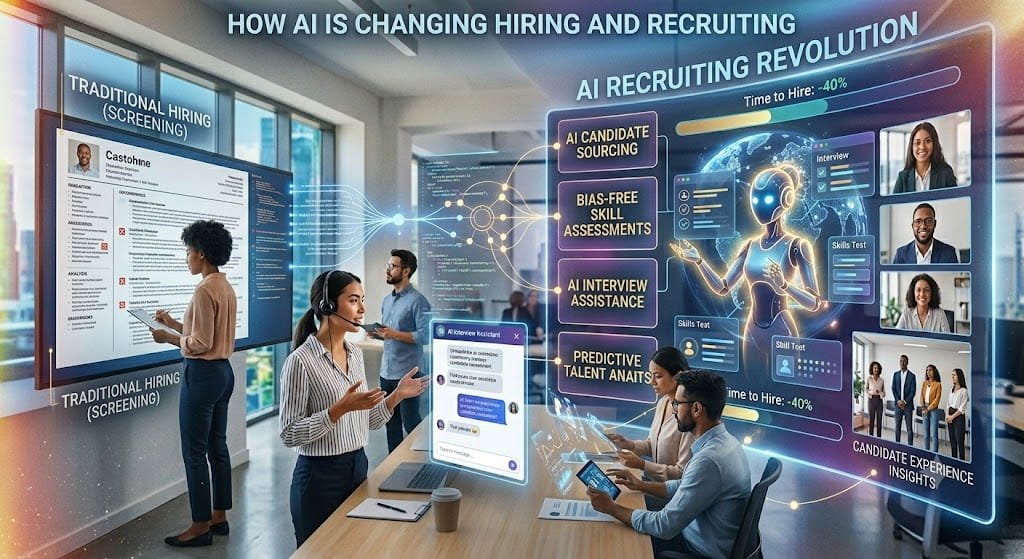
Artificial intelligence is rapidly transforming the way companies find, evaluate, and hire talent. What was once a heavily manual process involving hundreds of resumes, endless emails, and time-consuming interviews is becoming faster, smarter, and more data-driven.
As we move through 2025 and 2026, organizations of all sizes are investing in AI-powered recruiting tools to improve hiring efficiency, reduce costs, and identify top candidates more effectively.
If you’re wondering how AI is changing hiring and recruiting in 2025 and 2026, this guide explores the biggest trends shaping the future of talent acquisition.
Why AI Is Becoming Essential in Recruiting
Hiring has always been one of the most important business functions. However, recruiters often face challenges such as:
- High application volumes
- Limited hiring resources
- Slow hiring cycles
- Candidate drop-offs
- Skills shortages
- Unconscious bias
AI helps solve many of these problems by automating repetitive tasks and providing better insights throughout the recruitment process.
As competition for skilled workers increases, businesses are turning to AI to gain an advantage.
AI Resume Screening Is Becoming Standard
One of the biggest changes in recruiting is AI-powered resume screening.
Traditionally, recruiters manually reviewed hundreds or even thousands of applications.
Today, AI systems can:
- Analyze resumes within seconds
- Match candidates to job requirements
- Identify relevant skills
- Rank applicants
- Highlight top candidates
This allows recruiters to focus more on interviewing and relationship building rather than administrative work.
AI-Powered Candidate Sourcing Is Expanding
Finding qualified candidates has always been challenging.
Modern AI sourcing tools can search across:
- Professional networks
- Job boards
- Talent databases
- Company websites
- Social media platforms
These tools help recruiters identify potential candidates even before they actively apply for jobs.
This proactive approach is becoming increasingly important in competitive industries.
Chatbots Are Improving Candidate Experience
Recruitment chatbots are becoming common across many organizations.
AI chatbots can:
- Answer candidate questions
- Schedule interviews
- Provide application updates
- Share job information
- Guide applicants through hiring processes
Because chatbots are available 24/7, candidates receive faster responses and a smoother experience.
AI Interview Assistants Are Growing
Interview technology is evolving rapidly.
AI-powered interview assistants can:
- Record interviews
- Generate summaries
- Analyze responses
- Highlight key discussion points
- Assist hiring managers with evaluations
These tools help organizations manage large-scale hiring more efficiently.
However, human decision-making remains essential throughout the hiring process.
Skills-Based Hiring Is Replacing Traditional Credentials
One of the most significant recruiting trends for 2025 and 2026 is the shift toward skills-based hiring.
Instead of focusing solely on degrees or previous job titles, companies are increasingly evaluating:
- Technical skills
- Problem-solving ability
- Communication skills
- Industry knowledge
- Practical experience
AI helps identify these competencies more accurately by analyzing candidate profiles and assessments.
Predictive Analytics Is Influencing Hiring Decisions
AI systems are becoming better at predicting hiring outcomes.
Recruiters can use predictive analytics to estimate:
- Candidate success likelihood
- Retention probability
- Performance potential
- Cultural alignment
- Future skill development
Although predictions are not perfect, they provide valuable decision-support data.
Personalized Recruiting Is Becoming More Common
Candidates increasingly expect personalized experiences.
AI enables companies to deliver:
- Customized job recommendations
- Personalized communication
- Relevant career opportunities
- Tailored content
This creates stronger engagement and improves employer branding.
Internal Talent Mobility Is Growing
Organizations are increasingly using AI to identify internal talent.
Instead of hiring externally for every position, companies can use AI tools to:
- Match employees with opportunities
- Identify skill gaps
- Recommend training programs
- Support career development
This trend helps improve employee retention while reducing hiring costs.
Generative AI Is Supporting Recruiters
Generative AI is becoming a powerful tool for recruitment teams.
Recruiters now use AI to create:
Job Descriptions
AI can generate structured job descriptions quickly.
Candidate Outreach Messages
Recruiters can personalize emails at scale.
Interview Questions
AI can suggest role-specific interview questions.
Hiring Reports
AI can summarize candidate evaluations and recruitment data.
This significantly improves recruiter productivity.
AI Is Helping Reduce Administrative Work
Recruiters often spend a large portion of their time on repetitive tasks.
AI can automate:
- Scheduling
- Email communication
- Candidate tracking
- Resume parsing
- Status updates
- Data entry
Automation allows hiring teams to spend more time building relationships with candidates.
Ethical AI and Bias Reduction Are Major Priorities
As AI adoption increases, organizations are paying closer attention to ethics.
Key concerns include:
- Algorithmic bias
- Data privacy
- Transparency
- Fair hiring practices
- Candidate consent
Companies are investing in responsible AI practices to ensure recruiting decisions remain fair and compliant.
Remote Hiring Continues to Benefit From AI
The rise of remote and hybrid work has changed recruitment.
AI helps organizations manage global hiring by:
- Screening international candidates
- Coordinating virtual interviews
- Assessing remote skills
- Supporting multilingual recruitment
This expands access to talent beyond local markets.
Emerging Hiring Trends for 2026
Several trends are expected to accelerate during 2026.
AI Talent Marketplaces
Organizations will increasingly use AI-powered talent matching platforms.
Continuous Candidate Engagement
Recruiters will build long-term relationships with talent pools using AI-driven communication.
Workforce Planning
AI will play a larger role in forecasting future hiring needs.
Advanced Skills Mapping
Organizations will focus more on identifying emerging skill requirements.
Human-AI Collaboration
Recruiters and AI systems will work together rather than replacing each other.
Will AI Replace Recruiters?
One of the most common questions is whether AI will replace recruiters.
The answer is unlikely.
AI excels at:
- Data analysis
- Automation
- Administrative tasks
- Candidate matching
However, recruiters still provide critical human skills such as:
- Relationship building
- Negotiation
- Empathy
- Judgment
- Strategic hiring decisions
The future of recruiting is likely to involve collaboration between humans and AI rather than full automation.
Benefits of AI in Hiring
Organizations adopting AI recruitment technologies often experience:
- Faster hiring processes
- Lower recruitment costs
- Improved candidate experience
- Better candidate matching
- Increased recruiter productivity
- More data-driven decisions
These benefits explain why AI adoption continues to grow.
Challenges Recruiters Must Address
Despite its advantages, AI also introduces challenges.
Organizations must manage:
- Data quality issues
- Privacy concerns
- Bias risks
- Regulatory compliance
- Technology integration
- Candidate trust
Successful implementation requires thoughtful planning and oversight.
Final Thoughts
Understanding how AI is changing hiring and recruiting in 2025 and 2026 is essential for recruiters, hiring managers, HR professionals, and job seekers.
AI is transforming nearly every stage of the recruitment process, from sourcing and screening to engagement and workforce planning. While technology will continue to evolve, human expertise remains a critical part of successful hiring.
Organizations that combine AI efficiency with human judgment will likely achieve the best recruiting outcomes in the years ahead.
FAQs
How is AI changing recruiting in 2025 and 2026?
AI is automating resume screening, candidate sourcing, interview support, scheduling, and recruitment analytics.
Will AI replace recruiters?
No. AI supports recruiters but does not replace essential human skills such as relationship building, judgment, and communication.
What are the biggest AI recruiting trends?
Key trends include AI screening, predictive analytics, generative AI, skills-based hiring, talent marketplaces, and recruitment automation.
How does AI improve candidate experience?
AI provides faster communication, personalized recommendations, automated scheduling, and 24/7 support through chatbots.
What challenges does AI create in hiring?
Common concerns include bias, privacy, transparency, compliance, and maintaining trust in recruitment processes.