Is There Any Tool to Check ChatGPT AI Writing?
Introduction
ChatGPT and other AI writing tools are now used by bloggers, students, marketers, business owners, and content writers. These tools can help create blogs, emails, captions, product descriptions, and many other types of content.
But one common question is: is there any tool to check ChatGPT AI writing?
The simple answer is yes. There are many AI content detection tools available online. However, these tools have limits. They can give helpful signals, but they should not be trusted blindly.
In this guide, you will learn what AI writing checkers are, how they work, which tools are commonly used, and how to make AI-written content better and more natural.
What Is ChatGPT AI Writing?
ChatGPT AI writing means content created with the help of ChatGPT or similar artificial intelligence tools. The content may be fully written by AI or partly written by AI and edited by humans.
AI writing can include:
- Blog posts
- Essays
- Emails
- Social media captions
- Product descriptions
- Ad copy
- Website content
- Scripts
- FAQs
- Business documents
AI writing is useful because it saves time and helps generate ideas quickly. But it still needs human editing to make it more accurate, natural, and original.
What Is an AI Writing Checker?
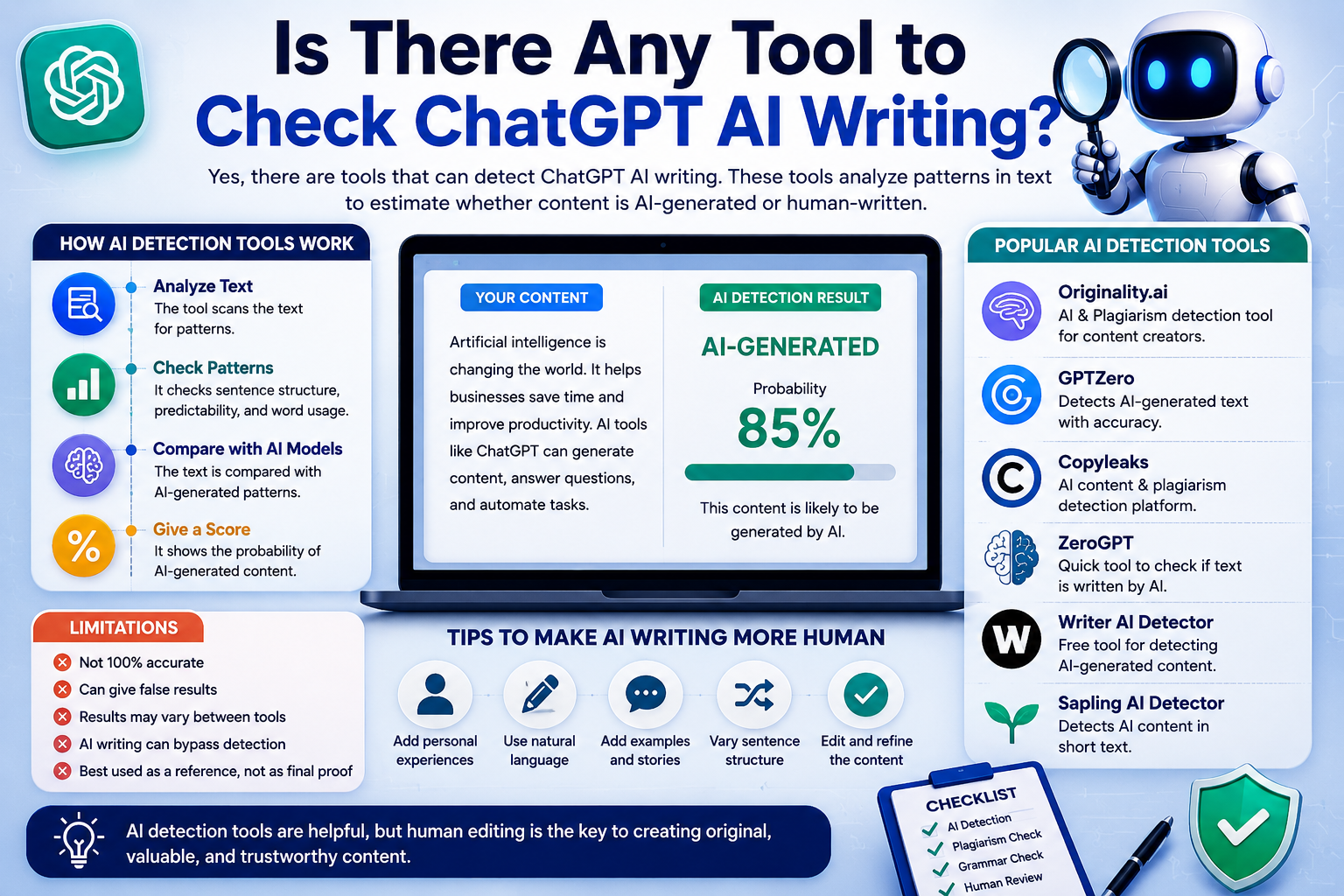
An AI writing checker is a tool that analyzes text and tries to identify whether it was written by a human or generated by AI.
These tools look for patterns in writing. They may check sentence structure, word choice, predictability, repetition, and overall writing style.
In simple words, an AI writing checker gives an estimate. It may say the text looks human-written, AI-generated, or mixed.
Is There Any Tool to Check ChatGPT AI Writing?
Yes, there are many tools that can check ChatGPT AI writing. Some popular AI detection tools include:
- Originality.ai
- GPTZero
- Copyleaks
- ZeroGPT
- Writer AI Detector
- Sapling AI Detector
- Turnitin AI detection
- Content at Scale AI Detector
These tools can help identify possible AI-generated content. But remember, no AI detector is perfect. They can sometimes mark human writing as AI or AI writing as human.
How Do AI Writing Detection Tools Work?
AI detection tools work by analyzing patterns in text. They check how predictable the writing is and whether the structure looks similar to AI-generated content.
Most AI detectors look at things like:
- Sentence length
- Word predictability
- Repeated phrases
- Writing smoothness
- Lack of personal experience
- Generic explanations
- Similar paragraph structure
- Overly perfect grammar
AI content often sounds very clean and balanced. Human writing usually has more variation, personal examples, emotion, and natural flow.
Popular Tools to Check ChatGPT AI Writing
Here are some commonly used tools.
| Tool | Best For | Notes |
|---|---|---|
| Originality.ai | Bloggers and publishers | Popular for AI and plagiarism checks |
| GPTZero | Students and teachers | Simple AI detection tool |
| Copyleaks | Businesses and education | AI and plagiarism detection |
| ZeroGPT | Quick checking | Easy to use |
| Writer AI Detector | Basic checks | Simple free option |
| Sapling AI Detector | Short text checks | Useful for quick testing |
| Turnitin | Education | Mostly used by schools and universities |
Each tool gives different results, so it is better to check content with more than one tool if accuracy matters.
1. Originality.ai
Originality.ai is a popular tool for bloggers, website owners, and content publishers. It checks AI content and plagiarism.
It is useful for people who publish content regularly and want to check whether the content sounds AI-generated.
It can help with:
- AI content detection
- Plagiarism checking
- Website content review
- Team content checking
- Blog content quality control
This tool is commonly used by SEO writers and content agencies.
2. GPTZero
GPTZero is another well-known AI detection tool. It is often used by students, teachers, and general users.
It checks whether content may have been created by AI and gives a result based on writing patterns.
GPTZero is useful for:
- Essay checking
- Blog checking
- Academic content review
- Quick AI writing analysis
It is simple to use and works well for basic checking.
3. Copyleaks
Copyleaks offers both AI detection and plagiarism checking. It is used by businesses, schools, and content teams.
It supports different types of content and can be useful for professional checking.
Copyleaks can help with:
- AI content detection
- Plagiarism detection
- Business content checking
- Academic content review
- Website content analysis
It is a good option for users who want both AI and plagiarism checks.
4. ZeroGPT
ZeroGPT is a simple online AI detector. Many users use it for quick checks because it is easy to access.
It can analyze text and show whether the content seems AI-written or human-written.
ZeroGPT is useful for:
- Quick checks
- Short articles
- Blog drafts
- Student content
- Simple AI detection
However, like other tools, it should not be treated as 100% accurate.
5. Writer AI Detector
Writer AI Detector is a basic tool that can check whether content may be AI-generated. It is simple and useful for quick testing.
It is best for people who want a fast check without many advanced features.
You can use it for:
- Website copy
- Blog paragraphs
- Emails
- Short drafts
- Marketing content
Are AI Detection Tools Accurate?
AI detection tools are helpful, but they are not always accurate. They can make mistakes.
Sometimes human-written content may be marked as AI because it is too clean or formal. Sometimes AI-written content may pass as human because it has been edited well.
This means AI detection tools should be used as a guide, not as final proof.
Common problems include:
- False positives
- False negatives
- Different tools showing different results
- Short text being harder to detect
- Edited AI content being difficult to identify
- Technical content sounding AI-like
So, if a tool says content is AI-written, it does not always mean the result is correct.
Why AI Detectors Give Different Results
Different AI detectors use different methods. That is why the same content may show different scores on different tools.
One tool may say the content is 80% AI. Another tool may say it is human-written.
This happens because each tool has its own system, training data, and scoring method.
That is why you should avoid depending on only one detector. Use AI detection tools carefully and combine them with human judgment.
Can Google Detect AI Content?
Google focuses more on content quality than how the content is created. If content is helpful, original, accurate, and useful for readers, it has a better chance of performing well.
The main problem is not AI content itself. The real problem is low-quality content, copied content, spammy content, or content written only to manipulate rankings.
For SEO, your content should be:
- Helpful
- Original
- Accurate
- Easy to read
- Written for users
- Well-structured
- Updated when needed
- Based on real value
Human editing is very important if you use AI for blog writing.
How to Make ChatGPT Writing More Human
AI writing can sometimes sound too perfect, general, or robotic. You can improve it with human editing.
To make ChatGPT writing more human:
- Add personal examples
- Use natural language
- Avoid repeated phrases
- Add real experience
- Use short and long sentences
- Remove generic lines
- Add opinions where suitable
- Use simple wording
- Add useful details
- Edit the flow manually
Human editing makes content more natural and trustworthy.
How to Check AI Writing Properly
Do not only paste content into one tool and accept the result. Use a better checking process.
Follow these steps:
| Step | What to Do |
|---|---|
| Step 1 | Read the content yourself |
| Step 2 | Check for robotic tone |
| Step 3 | Use one or two AI detectors |
| Step 4 | Check plagiarism |
| Step 5 | Add human examples |
| Step 6 | Improve sentence flow |
| Step 7 | Review facts |
| Step 8 | Final edit before publishing |
This process gives better results than relying only on AI detection.
AI Detection vs Plagiarism Checking
AI detection and plagiarism checking are different.
AI detection checks whether content may be generated by AI. Plagiarism checking checks whether content is copied from another source.
Here is the difference:
| Type | What It Checks |
|---|---|
| AI detection | Whether text looks AI-generated |
| Plagiarism check | Whether text is copied |
| Grammar check | Whether writing has grammar issues |
| SEO check | Whether content is optimized |
For blog publishing, it is good to check both AI detection and plagiarism.
Best Tool for Bloggers
For bloggers, Originality.ai and Copyleaks are commonly used because they offer AI detection and plagiarism checking.
However, bloggers should not focus only on AI score. They should focus on content quality, helpfulness, originality, and user experience.
A blog should answer the reader’s question clearly. If the content is useful and edited properly, it can perform better.
Best Tool for Students
For students, GPTZero, Turnitin, and Copyleaks are commonly used. Many schools and universities use AI detection tools to check assignments.
Students should follow their institution’s rules about AI use. Some teachers allow AI for ideas, while others may not allow AI-written content.
The safest option is to use AI for brainstorming and learning, not for submitting complete unedited work.
Best Tool for Marketers
For marketers, AI detection tools can help check ad copy, blogs, emails, and website content.
Useful tools for marketers include:
- Originality.ai
- Copyleaks
- Writer AI Detector
- GPTZero
- Grammarly
- Plagiarism checkers
Marketers should focus on brand voice, clarity, accuracy, and conversion quality.
Should You Worry About AI Detection?
You should not panic about AI detection, but you should take content quality seriously.
AI tools can help with writing, but the final content should feel human, helpful, and original.
Instead of only asking, “Will this pass AI detection?” ask:
- Is this content useful?
- Is it accurate?
- Does it answer the topic properly?
- Does it sound natural?
- Is it original?
- Does it match my audience?
- Does it provide real value?
These questions are more important for long-term success.
Common Mistakes to Avoid
Avoid these mistakes when checking ChatGPT AI writing:
- Trusting one AI detector completely
- Publishing AI content without editing
- Ignoring plagiarism checks
- Using generic AI paragraphs
- Repeating the same sentence style
- Not adding examples
- Not checking facts
- Focusing only on AI score
- Ignoring reader experience
Good content should be written for people first.
Tips to Make AI Content Better
Use these tips before publishing AI-assisted content:
- Add a strong introduction
- Include practical examples
- Use short paragraphs
- Add tables where useful
- Use simple language
- Include FAQs
- Add real insights
- Avoid keyword stuffing
- Check grammar
- Make the content easy to scan
These steps can improve both quality and readability.
FAQs
Is there any tool to check ChatGPT AI writing?
Yes, tools like Originality.ai, GPTZero, Copyleaks, ZeroGPT, Writer AI Detector, and Turnitin can check whether content may be AI-generated.
Are AI writing detectors accurate?
AI detectors are not always accurate. They can give false results, so they should be used as a guide, not final proof.
Can AI-written content rank on Google?
AI-assisted content can rank if it is helpful, original, accurate, and useful for readers. Low-quality or spammy content can perform poorly.
What is the best AI detector for bloggers?
Originality.ai and Copyleaks are popular choices for bloggers because they check both AI writing and plagiarism.
How can I make ChatGPT writing sound human?
You can make it sound human by editing the content, adding examples, using natural language, changing sentence structure, and including real experience.
Conclusion
So, is there any tool to check ChatGPT AI writing? Yes, there are many tools available, such as Originality.ai, GPTZero, Copyleaks, ZeroGPT, Writer AI Detector, and Turnitin.
However, these tools are not perfect. They can give wrong results, so you should not depend on them completely.
The best approach is to use AI detectors as a guide, check plagiarism, edit the content manually, add human examples, and focus on helpful writing. In the end, quality content matters more than just an AI detection score.