
How to Read Guitar Tabs: The Complete Beginner’s Guide (2026)
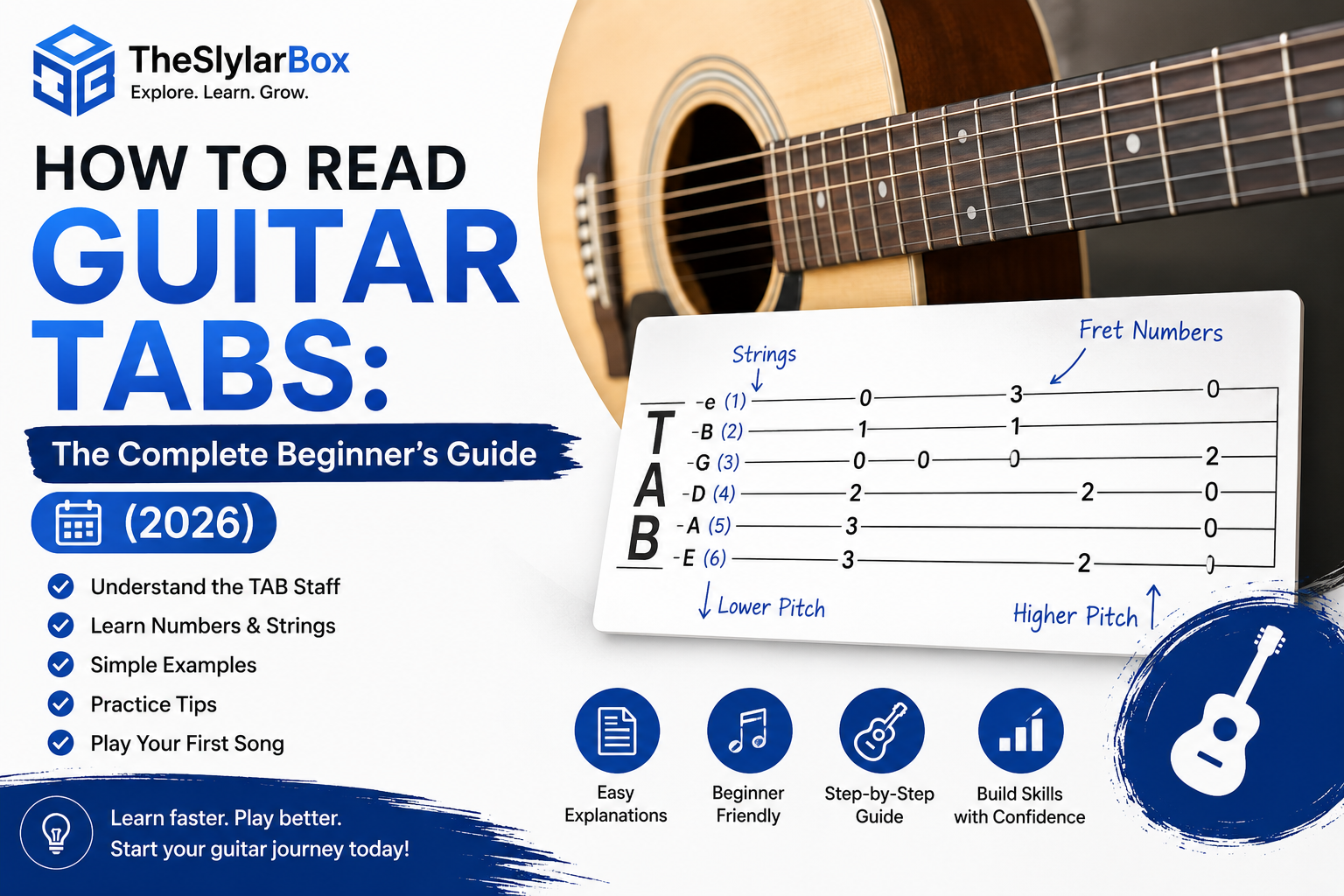
Learning how to read guitar tabs is the fastest way to start playing real music on the guitar, even if you have never read a note of traditional sheet music in your life. Guitar tablature (tab for short) is a simple visual system that shows you exactly which string to play and which fret to press, using six horizontal lines and numbers instead of musical notation. Within about fifteen minutes of understanding the basics, most complete beginners can follow a simple tab, and that is exactly what this guide will get you to.
In this complete tutorial, I will walk you through how to read guitar tabs step by step: what the six lines mean, how the numbers work, how to tell chords apart from single notes, what all those extra symbols like h, p, b, and x mean, the one big thing tabs do not tell you, the mistakes almost every beginner makes, and a simple practice routine to make tab reading feel automatic. Grab your guitar, and let’s decode your first tab.
What Are Guitar Tabs? (Quick Answer)
Quick answer: Guitar tabs (tablature) are a form of written music designed specifically for guitar. A tab consists of six horizontal lines representing the six strings of the guitar, with numbers placed on those lines telling you which fret to press on which string. Unlike standard sheet music, tabs do not require any knowledge of music theory or note reading, which is why they have become the most popular way for guitarists to learn songs, and why millions of free tabs exist online for nearly every song imaginable.
Tabs are read from left to right, just like text. Numbers that appear one after another are played one after another; numbers stacked vertically on top of each other are played at the same time. That is genuinely 80% of the system. The rest is details, and here they are.
Understanding the Six Lines: Your Strings
Here is the single most important thing to learn, and the one beginners most often get backwards. A blank guitar tab looks like this:
e|—————————–|
B|—————————–|
G|—————————–|
D|—————————–|
A|—————————–|
E|—————————–|
Each line is one string of your guitar, and here is the crucial part:
- The TOP line of the tab is your THINNEST string (high e, the one closest to the floor when you hold the guitar).
- The BOTTOM line of the tab is your THICKEST string (low E, the one closest to your face).
This feels upside down to nearly everyone at first, because the top line of the tab is physically the lowest string on your guitar. The way to remember it: the tab shows pitch, not physical position. Higher-sounding strings sit higher on the tab, exactly like higher notes sit higher on sheet music. Say it to yourself once more before moving on: top tab line = thin string. Getting this wrong is the number one reason beginner tabs “sound wrong.”
The lowercase e and uppercase E in the string labels help you tell them apart: lowercase e is the thin high string, uppercase E is the thick low string. From top to bottom, the standard tuning labels read e, B, G, D, A, E.
Understanding the Numbers: Your Frets
Numbers on the lines tell you which fret to press on that string:
- 0 means open string — pluck the string without pressing any fret.
- 1 means first fret, 2 means second fret, 3 means third fret, and so on.
- Higher numbers (like 12) simply mean frets further up the neck toward the guitar’s body.
Here is a simple example — this is an original practice line, not from any song:
e|————————-|
B|————————-|
G|————————-|
D|————————-|
A|—-0—2—3—2—0—-|
E|————————-|
Reading left to right, this says: on the A string (second line from the bottom), play the open string, then the 2nd fret, then the 3rd fret, then back to the 2nd fret, then open again. Five notes, one after another, all on one string. Congratulations — you just read a guitar tab.
Single Notes vs Chords: Horizontal vs Vertical
This is the second core rule of how to read guitar tabs:
- Numbers in a horizontal sequence = play them one at a time, in order.
- Numbers stacked vertically = play them all at the same time (a chord).
Here is a G major chord written in tab:
e|—-3—-|
B|—-0—-|
G|—-0—-|
D|—-0—-|
A|—-2—-|
E|—-3—-|
All six numbers are stacked in one vertical column, so you press 3rd fret on the low E string, 2nd fret on the A string, leave the D, G, and B strings open, press 3rd fret on the high e string, and strum all six strings together in one motion.
And here is the difference in action. This next example plays that same chord shape one string at a time (called an arpeggio):
e|——————3—-|
B|————–0——–|
G|———-0————|
D|——0—————-|
A|–2——————–|
E|3———————-|
Same finger shape, but because the numbers appear one after another instead of stacked, you pick each string individually from low to high.
Guitar Tab Symbols Explained (The Complete Cheat Sheet)
Beyond lines and numbers, tabs use letters and symbols to describe how to play a note. Here are the ones you will actually encounter, in rough order of how often you will see them:
| Symbol | Name | What You Do |
| h (e.g. 5h7) | Hammer-on | Pick the first note (fret 5), then “hammer” a finger down onto fret 7 without picking again |
| p (e.g. 7p5) | Pull-off | Pick fret 7, then pull that finger off to sound fret 5 without picking again |
| b (e.g. 7b9) | Bend | Pick fret 7 and bend the string upward until it sounds like fret 9 |
| r (e.g. 7b9r7) | Release | Release a bend back down to the original pitch |
| / (e.g. 5/7) | Slide up | Pick fret 5 and slide your finger up to fret 7 while the note rings |
| \ (e.g. 7\5) | Slide down | Same idea, sliding down the neck |
| x | Muted note | Rest your fretting hand lightly on the string and strike it for a percussive “chuck” sound, no clear pitch |
| ~ or v | Vibrato | Wiggle the fretted note rapidly for a singing, wavering sound |
| PM (with dashes) | Palm mute | Rest the edge of your picking palm lightly on the strings near the bridge while picking, for a chunky, muted tone |
| t | Tapping | Tap the fret with a finger of your picking hand |
| ( ) (e.g. (7)) | Ghost note | Play the note very softly, or it indicates a note still ringing from a bend or slide |
Do not try to memorize this table today. Learn h, p, b, and / first — they cover the vast majority of what appears in beginner and intermediate tabs — and let the rest arrive naturally as you meet them in songs.
The One Big Thing Tabs Don’t Tell You: Rhythm
Here is the honest limitation of tablature, and understanding it will save you months of confusion: standard text tabs do not show you rhythm. The numbers tell you what to play, but not how long each note lasts or exactly when it lands.
This is why two beginners can play the same tab and one sounds like the song while the other sounds like a random string of notes. The missing ingredient is timing, and there are three practical ways to get it:
- Listen to the song, a lot. The recording is your rhythm guide. Learn the tab’s notes slowly, then match them to what you hear. This is how the majority of tab users actually learn songs, and training your ear this way is a hidden benefit of tabs.
- Use tabs with rhythm notation. Interactive tab software and apps (like Guitar Pro, Songsterr-style players, and similar tools) play the tab back with correct timing, so you can hear exactly how it should sound and slow it down.
- Watch a lesson video alongside the tab. Seeing someone’s picking hand while following the tab fills in the timing gap quickly.
My recommendation for beginners: always learn a tab with the recording playing. Tab plus your ears is a complete system; tab alone is half of one.
How to Read Guitar Tabs: Step-by-Step Practice Method
Here is the exact process to go from “I understand the theory” to “I can actually play from tabs”:
- Choose a very simple riff you already know by ear. Familiar melodies work best because your ear already knows the rhythm.
- Read the tab away from the guitar first. Trace it left to right and say it aloud: “open A, 2nd fret A, 3rd fret A…” This builds reading fluency separately from finger skills.
- Find the strings and frets slowly, one note at a time. Accuracy first. Speed is a byproduct of accuracy, never the other way around.
- Loop tiny chunks. Take two to four notes and repeat them ten times before adding the next chunk. Small loops build muscle memory dramatically faster than playing the whole thing badly.
- Add the recording. Play along at whatever speed you can manage; use a slower playback speed if your app allows it.
- Repeat daily in short sessions. Ten focused minutes a day beats one exhausted hour on Sunday. Within two to three weeks, reading tabs will start feeling automatic.
Common Beginner Mistakes When Reading Guitar Tabs
Save yourself frustration by avoiding these five classic errors:
- Reading the strings upside down. The top tab line is the thin high e string. If a tab sounds completely wrong, check this first — it is almost always the culprit.
- Confusing fret numbers with finger numbers. The numbers are frets, not fingers. A 3 means 3rd fret, played with whichever finger is sensible, not necessarily your third finger.
- Ignoring the symbols. Beginners often play 5h7 as two picked notes. The song will sound stiff and wrong. Symbols are not decorations; they are the technique.
- Learning tabs without the song. As covered above, tabs carry no rhythm. Playing a tab you have never heard is guessing, not learning.
- Trusting bad tabs. User-submitted tabs online vary wildly in accuracy. If a tab sounds off even when you play it correctly, check its rating or compare a second version — inaccurate tabs are common, and your ear is the final judge.
Frequently Asked Questions About Reading Guitar Tabs
Are guitar tabs easier than sheet music?
Yes, significantly. Guitar tabs show exactly where to put your fingers with no music theory required, which is why beginners can read simple tabs within minutes. Sheet music carries more information (especially rhythm) but takes months to read fluently. Many guitarists use tabs their entire playing lives.
What do the numbers mean on guitar tabs?
The numbers indicate frets: 0 means play the string open (no fret pressed), 1 means first fret, 5 means fifth fret, and so on. The line the number sits on tells you which string to play, with the top line representing the thinnest string.
How do I know which fingers to use on guitar tabs?
Tabs usually do not specify fingers — the numbers refer to frets, not fingers. A practical rule for beginners: within a small area of the neck, assign one finger per fret (index for the lowest fret in the passage, then middle, ring, and pinky in order), and adjust for comfort.
Why does my tab sound different from the song?
The three most common causes: reading the tab upside down (top line is the thin string), missing the rhythm because text tabs do not notate timing, or using an inaccurate user-submitted tab. Play along with the recording and compare a second tab version to diagnose.
What does h, p, and b mean in guitar tabs?
The letter h means hammer-on (sound the second note by pressing a finger down hard without re-picking), p means pull-off (sound a lower note by pulling your finger off the string), and b means bend (push the string upward to raise its pitch to the target fret’s sound).
Can I learn guitar with tabs only?
Yes — countless self-taught guitarists learned entirely from tabs combined with listening. Tabs cover the “where,” recordings cover the “when,” and adding basic chord knowledge fills most remaining gaps. Sheet music becomes relevant mainly for classical, jazz, or session work.
Final Thoughts: Your First Week with Guitar Tabs
Learning how to read guitar tabs comes down to three ideas: the six lines are your strings with the thinnest on top, the numbers are frets read left to right, and stacked numbers are played together. Add the handful of technique symbols (h, p, b, and slides) and the habit of always pairing a tab with its recording, and you have the complete toolkit that most of the world’s guitarists use every day.
For your first week, keep it simple: ten minutes daily, one easy riff you love, tiny loops, recording playing in the background. By day seven, the tab will have stopped looking like a puzzle and started looking like music. And that moment, when the lines and numbers turn into a song you recognize under your own fingers, is exactly why tabs have hooked every generation of guitar players since they appeared.
What song are you learning first? Share it in the comments, and check out our other beginner skill guides here on Slylar Box.