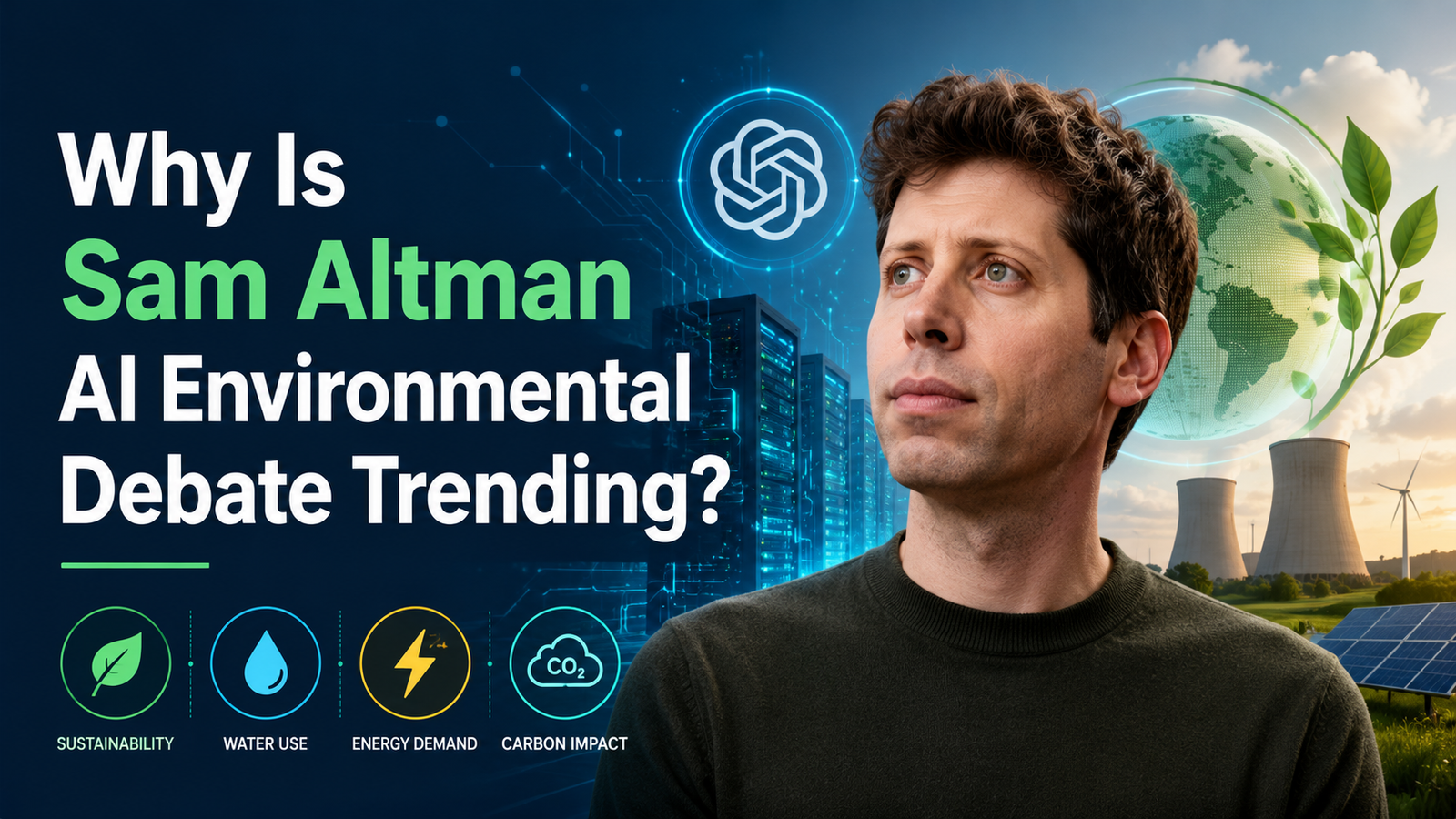
Why Is Sam Altman AI Environmental Debate Trending?
Introduction
Artificial intelligence is growing very fast. People are using AI tools for writing, coding, research, images, videos, business work, and daily tasks.
But now, another question is becoming popular: why is Sam Altman AI environmental debate trending?
The simple answer is that people are discussing how much energy and water AI systems use. Sam Altman, the CEO of OpenAI, made comments about AI energy use, ChatGPT queries, data centers, and the need for cleaner energy. His comments started a bigger debate about whether AI is good for the future or harmful for the environment.
This topic is trending because AI is useful, but it also needs huge data centers, electricity, cooling systems, chips, and infrastructure.
Who Is Sam Altman?
Sam Altman is the CEO of OpenAI, the company behind ChatGPT.
He is one of the most talked-about people in the AI industry because OpenAI has played a major role in making generative AI popular around the world.
When Sam Altman says something about AI, people pay attention. His comments often create discussion among tech experts, investors, environmental groups, students, bloggers, and normal users.
This is why the Sam Altman AI environmental debate became a trending topic.
What Is the AI Environmental Debate?
The AI environmental debate is about the real-world cost of running artificial intelligence.
AI may feel simple when someone types a question into ChatGPT, but behind the screen, powerful computers are working inside data centers.
These data centers need:
- Electricity
- Cooling systems
- Water in some cases
- Computer chips
- Large buildings
- Power grids
- Backup systems
Because AI use is growing quickly, people are asking if the environmental cost is too high.
Why Is Sam Altman AI Environmental Debate Trending?
The debate is trending because Sam Altman responded to concerns about AI’s energy and water use.
In one discussion, Altman defended AI’s energy use by comparing the energy needed to train AI with the energy needed for human development. He also said that public concern about AI energy use is fair and that society needs to move quickly toward cleaner energy sources like nuclear, wind, and solar.
This created debate because some people agreed with him, while others felt that comparing AI and humans was strange or insensitive.
So the topic became popular because it includes technology, climate, business, ethics, and public trust.
ChatGPT Energy Use Is Part of the Debate
One reason this topic is trending is that people want to know how much energy ChatGPT uses.
In a June 2025 blog post, Sam Altman said an average ChatGPT query uses about 0.34 watt-hours of electricity and about 0.000085 gallons of water. He compared the electricity use to what a high-efficiency lightbulb uses in a few minutes.
These numbers made people talk even more.
Some people said the per-query energy use sounds small. Others said the real issue is scale. If hundreds of millions of people use AI every day, even small amounts can become huge when added together.
AI Data Centers Need a Lot of Electricity
The bigger issue is not only one AI query. The bigger issue is the growth of AI data centers.
The International Energy Agency says global data center electricity consumption could reach around 945 TWh by 2030, almost double the current level. It also says electricity use from AI-focused data centers is growing much faster than normal data center demand.
This is why environmental experts are worried.
AI companies need more data centers to train and run powerful models. More data centers mean more pressure on electricity grids, especially in areas where power systems are already under stress.
Water Use Is Also Part of the Debate
Water use is another reason the Sam Altman AI environmental debate is trending.
Some data centers use water for cooling. Cooling is important because AI servers can become very hot when they run heavy workloads.
Altman pushed back against some viral claims about AI water use and said many newer data centers have moved away from older water-heavy cooling methods. However, critics still argue that water use remains an important issue because not all data centers are new or efficient.
This makes the debate more complicated.
AI companies may say newer systems are becoming cleaner, but environmental groups want more transparency about real energy and water numbers.
Why Environmental Groups Are Concerned
Environmental groups are concerned because AI infrastructure is growing very quickly.
Data centers can increase demand for electricity, water, land, chips, and cooling systems. If that electricity comes from fossil fuels, AI growth can increase carbon emissions.
The Guardian reported that more than 230 environmental groups called for a pause on new data center construction in the United States because of concerns about climate, water, and community impacts.
This shows that the debate is not only about technology. It is also about local communities, energy bills, climate goals, and resource use.
Why AI Companies Defend Energy Use
AI companies defend energy use because they believe AI can bring big benefits.
Supporters say AI can help with:
- Scientific research
- Medical discovery
- Climate modeling
- Energy optimization
- Education
- Productivity
- Business automation
- Coding and software development
Sam Altman has also argued that AI and energy could become abundant in the future, and that cheaper intelligence may unlock major progress.
The main argument from AI supporters is simple: AI may use energy, but it may also help solve major problems.
The main argument from critics is also simple: future benefits should not be used to ignore today’s environmental costs.
Why the Debate Is Not Simple
The Sam Altman AI environmental debate is not simple because both sides have valid points.
AI does use real energy and infrastructure. That cannot be ignored.
At the same time, not every viral claim about AI energy or water use is accurate. Some online numbers may be exaggerated, outdated, or missing context.
The real question is not whether AI uses resources. It does.
The better question is: how can AI be made cleaner, more transparent, and more useful without damaging the environment?
Nuclear, Wind, and Solar Are Part of the Discussion
Clean energy is now a big part of the AI debate.
Altman said society needs to move quickly toward nuclear, wind, and solar energy. This is important because AI data centers need reliable power, and clean energy can reduce the climate impact of AI.
Many tech companies are now looking at renewable energy and nuclear power because AI infrastructure needs stable electricity.
However, building clean energy projects takes time. This is why some critics worry that AI demand may grow faster than clean energy supply.
Why Bloggers Are Writing About This Topic
Bloggers are writing about the Sam Altman AI environmental debate because people want simple explanations.
Many users do not understand how AI data centers work. They only see the chatbot interface. They do not see the servers, chips, cooling systems, power use, or water use behind it.
This topic is useful for:
- AI blogs
- Tech websites
- Environment blogs
- Business websites
- News blogs
- Student research articles
- Sustainability websites
It is also a good SEO topic because it connects AI, climate, OpenAI, ChatGPT, and Sam Altman.
Is AI Bad for the Environment?
AI is not automatically bad for the environment, but it does have an environmental impact.
The impact depends on:
- How much electricity AI uses
- Where that electricity comes from
- How efficient the data center is
- Whether water is used for cooling
- How often people use AI tools
- How large the AI model is
- Whether AI creates real benefits
If AI is powered by clean energy and used for valuable work, its impact may be easier to justify.
But if AI is used mainly for low-value tasks while consuming huge resources, people will question whether it is worth the cost.
What Should AI Companies Do?
AI companies should be more transparent.
They should clearly share:
- Energy use
- Water use
- Carbon emissions
- Data center locations
- Cooling methods
- Clean energy plans
- Efficiency improvements
The European Union has also proposed stronger energy-efficiency standards and sustainability labels for data centers because of growing concerns about AI’s environmental impact.
More transparency can help users, governments, and researchers understand the real environmental cost of AI.
Final Thoughts
So, why is Sam Altman AI environmental debate trending?
It is trending because AI is growing fast, and people are worried about the energy, water, and climate impact of AI data centers.
Sam Altman’s comments brought more attention to this issue. Some people agreed that AI’s benefits may justify its energy use. Others criticized the comparison between AI and humans and argued that tech companies must be more transparent.
The truth is that AI is powerful, but it is not weightless. It needs real electricity, real infrastructure, and sometimes real water.
The future of AI will depend not only on better models, but also on cleaner energy, efficient data centers, honest reporting, and responsible use.
FAQs
Why is Sam Altman AI environmental debate trending?
It is trending because Sam Altman commented on AI energy and water use, and people are debating whether AI’s benefits justify its environmental cost.
What is the AI environmental debate?
The AI environmental debate is about how much electricity, water, and infrastructure AI systems need, especially large AI data centers.
Does ChatGPT use electricity?
Yes, ChatGPT uses electricity because AI models run on powerful servers in data centers.
How much energy does a ChatGPT query use?
Sam Altman said an average ChatGPT query uses about 0.34 watt-hours of electricity, but researchers and critics still debate how AI’s total impact should be measured.
Why are data centers important in this debate?
Data centers are important because they power AI systems. As AI grows, data centers need more electricity, cooling, chips, and infrastructure.
Can AI become more environmentally friendly?
Yes, AI can become cleaner if companies use renewable energy, improve efficiency, reduce water use, and share transparent environmental data.