How to Start an AI Voice Recorder Business: Complete Strategy Guide for 2026
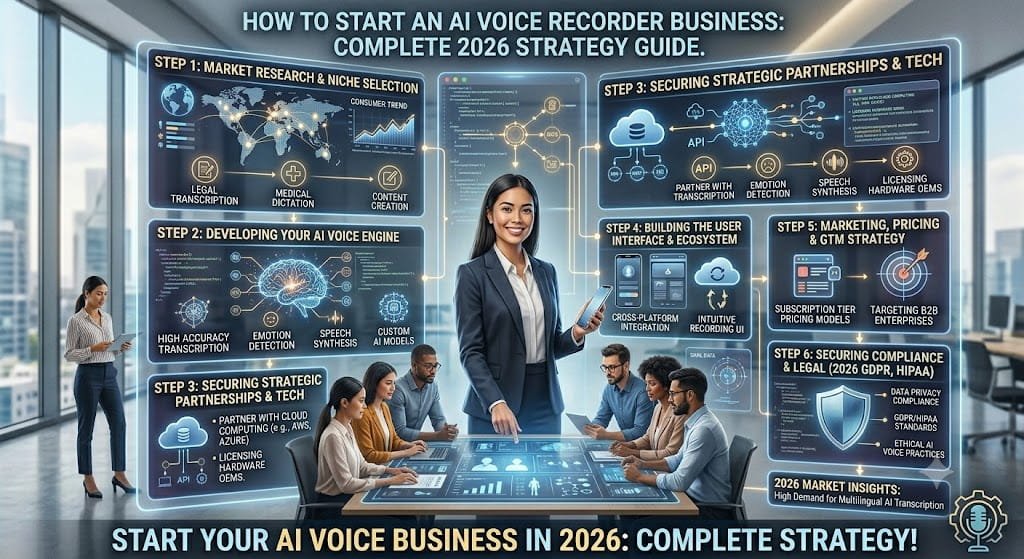
Artificial intelligence is transforming the way people record, transcribe, organize, and analyze audio. Businesses, students, journalists, podcasters, lawyers, doctors, and content creators are increasingly looking for smart voice recording solutions that do much more than simply capture sound.
This growing demand has created a major opportunity for entrepreneurs interested in building an AI voice recorder business.
If you’re searching for how to start an AI voice recorder business strategy, this guide covers everything from choosing a business model to acquiring customers and scaling operations.
Why the AI Voice Recorder Market Is Growing
Traditional voice recorders simply store audio files.
Modern AI voice recorders can:
- Convert speech to text
- Summarize conversations
- Generate meeting notes
- Identify speakers
- Search audio content
- Translate languages
- Create action items automatically
Businesses are willing to pay for tools that save time and increase productivity.
As remote work and online communication continue to expand, demand for AI-powered voice solutions is expected to grow significantly through 2026 and beyond.
Understanding the AI Voice Recorder Business Opportunity
There are several ways to enter this market.
You do not necessarily need to build complex AI technology from scratch.
Many successful businesses leverage existing AI models and focus on solving specific customer problems.
Business Model #1: AI Meeting Assistant
This is currently one of the fastest-growing sectors.
The software records meetings and automatically creates:
- Meeting summaries
- Action items
- Key discussion points
- Searchable transcripts
Target customers include:
- Startups
- Agencies
- Sales teams
- Consultants
- Remote companies
Business Model #2: AI Transcription Service
Many industries require accurate transcription.
Examples include:
- Journalists
- Researchers
- Lawyers
- Healthcare providers
- Educational institutions
You can provide AI-powered transcription combined with human review for higher accuracy.
Business Model #3: Voice Notes App
Many professionals record ideas throughout the day.
An AI voice notes application can:
- Record audio
- Convert speech to text
- Categorize notes
- Generate summaries
- Organize tasks automatically
This model appeals to entrepreneurs, executives, students, and creators.
Business Model #4: Industry-Specific AI Recorder
Niche solutions often outperform generic products.
Examples include:
Medical Voice Recorder
Designed for doctors and clinics.
Legal Voice Recorder
Built for lawyers and law firms.
Real Estate Voice Recorder
Helps agents document client interactions.
Education Voice Recorder
Creates notes from lectures and training sessions.
Niche markets often have less competition and higher pricing potential.
Step 1: Identify a Target Audience
One of the biggest mistakes founders make is trying to serve everyone.
Instead, choose a specific audience.
Examples:
- Students
- Podcasters
- Journalists
- Sales teams
- Consultants
- Real estate agents
- Lawyers
- Healthcare professionals
The more specific your audience, the easier marketing becomes.
Step 2: Validate Demand Before Building
Before investing heavily in development, confirm people will actually pay.
Methods include:
- Online surveys
- Reddit discussions
- Facebook groups
- LinkedIn communities
- Industry forums
- Customer interviews
Ask potential customers:
- What problems they face
- Which tools they currently use
- What features they want
- How much they would pay
Step 3: Build an MVP
MVP stands for Minimum Viable Product.
Focus only on essential features such as:
- Audio recording
- AI transcription
- Speaker identification
- Summarization
Avoid adding dozens of features initially.
Launch quickly and gather user feedback.
Step 4: Choose AI Technology
Several AI technologies can power your product.
Common capabilities include:
Speech-to-Text
Converts audio into written text.
Natural Language Processing
Analyzes conversation content.
Summarization Models
Creates concise summaries.
Translation Systems
Supports multiple languages.
Voice Recognition
Identifies different speakers.
You can integrate existing AI APIs rather than building your own models.
Step 5: Create a Revenue Model
Your pricing structure is critical.
Popular options include:
Monthly Subscription
Users pay recurring fees.
Freemium Model
Basic features are free while advanced features require payment.
Pay Per Minute
Charges are based on audio usage.
Enterprise Licensing
Businesses pay for organization-wide access.
Subscription models generally create more predictable revenue.
Step 6: Build a Strong Brand
The AI software market is becoming crowded.
A strong brand helps you stand out.
Focus on:
- Simple messaging
- Professional design
- Clear positioning
- Customer trust
- Consistent branding
Customers need to understand your value within seconds.
Step 7: Launch Your Marketing Strategy
Marketing is often more important than technology.
Effective channels include:
SEO
Create content targeting keywords such as:
- AI meeting notes
- AI transcription software
- Voice note app
- Audio transcription tool
YouTube
Demonstrate how your product works.
Target professionals and businesses.
Product Hunt
Launch your product to early adopters.
Partnerships
Collaborate with agencies and consultants.
Step 8: Focus on User Retention
Acquiring customers is expensive.
Keeping customers is where profits are generated.
Improve retention by:
- Delivering accurate results
- Adding requested features
- Providing excellent support
- Improving user experience
- Reducing onboarding friction
Satisfied users often become your best marketers.
Competitive Advantages That Matter
Many founders worry about competition.
Instead of trying to build everything, focus on creating advantages.
Examples include:
Specialized Data
Industry-specific knowledge creates defensibility.
Workflow Integration
Connect with tools customers already use.
Better User Experience
Simple products often outperform feature-heavy competitors.
Community Building
Strong communities create loyalty.
Brand Trust
Trust becomes increasingly important as AI adoption grows.
Common Mistakes to Avoid
Building Before Validation
Always confirm demand first.
Targeting Everyone
Niche audiences are easier to serve.
Ignoring Distribution
Marketing matters as much as development.
Overcomplicating the Product
Start simple and improve gradually.
Competing Only on Price
Focus on value instead of being the cheapest option.
Future Trends in AI Voice Recording
Several trends are expected to shape the industry.
Real-Time Summaries
Users will receive instant meeting insights.
Multilingual Transcription
Support for more languages will expand.
Voice Search
Audio content will become easier to search.
Personalized AI Assistants
AI will provide context-aware recommendations.
Deeper Workflow Automation
Voice recorders will become productivity platforms.
Is an AI Voice Recorder Business Worth Starting?
The market opportunity is significant.
Organizations are generating more audio content than ever before, and AI can help transform that information into actionable insights.
Founders who focus on a clear niche, solve real problems, and build effective distribution channels can create sustainable businesses in this growing sector.
Final Thoughts
Learning how to start an AI voice recorder business strategy begins with understanding customer problems rather than technology.
The most successful businesses will not necessarily have the most advanced AI. They will be the ones that solve specific problems, create excellent user experiences, and build strong relationships with customers.
For entrepreneurs looking to enter the AI software market in 2026, voice recording and transcription remain one of the most promising opportunities.
FAQs
What is an AI voice recorder business?
It is a business that uses artificial intelligence to record, transcribe, summarize, organize, or analyze audio content.
Do I need to build my own AI model?
No. Many startups use existing AI APIs and focus on product development and customer experience.
Who are the best customers for AI voice recording software?
Popular customer groups include businesses, students, journalists, consultants, lawyers, healthcare professionals, and content creators.
How do AI voice recorder businesses make money?
Common revenue models include subscriptions, enterprise licensing, freemium plans, and usage-based pricing.
Is the AI voice recorder market growing?
Yes. Demand for transcription, meeting summaries, voice notes, and productivity tools continues to increase globally.