HOW TO RANK IN GOOGLE AI OVERVIEWS: WHAT ACTUALLY WORKS
Google AI Overviews don’t rank pages the way traditional search does they select and synthesize passages from a handful of sources that already rank well, answer the query directly in the first few sentences, and carry clear trust signals. To get featured, your content needs three things at once: strong existing organic rankings, a direct answer positioned at the top of the page, and structured, well-sourced content that’s easy for an AI system to extract and quote.
That’s the short version. Here’s the full breakdown of how AI Overviews actually work, and the exact steps to give your content a real shot at being included.
What Are Google AI Overviews, Exactly?
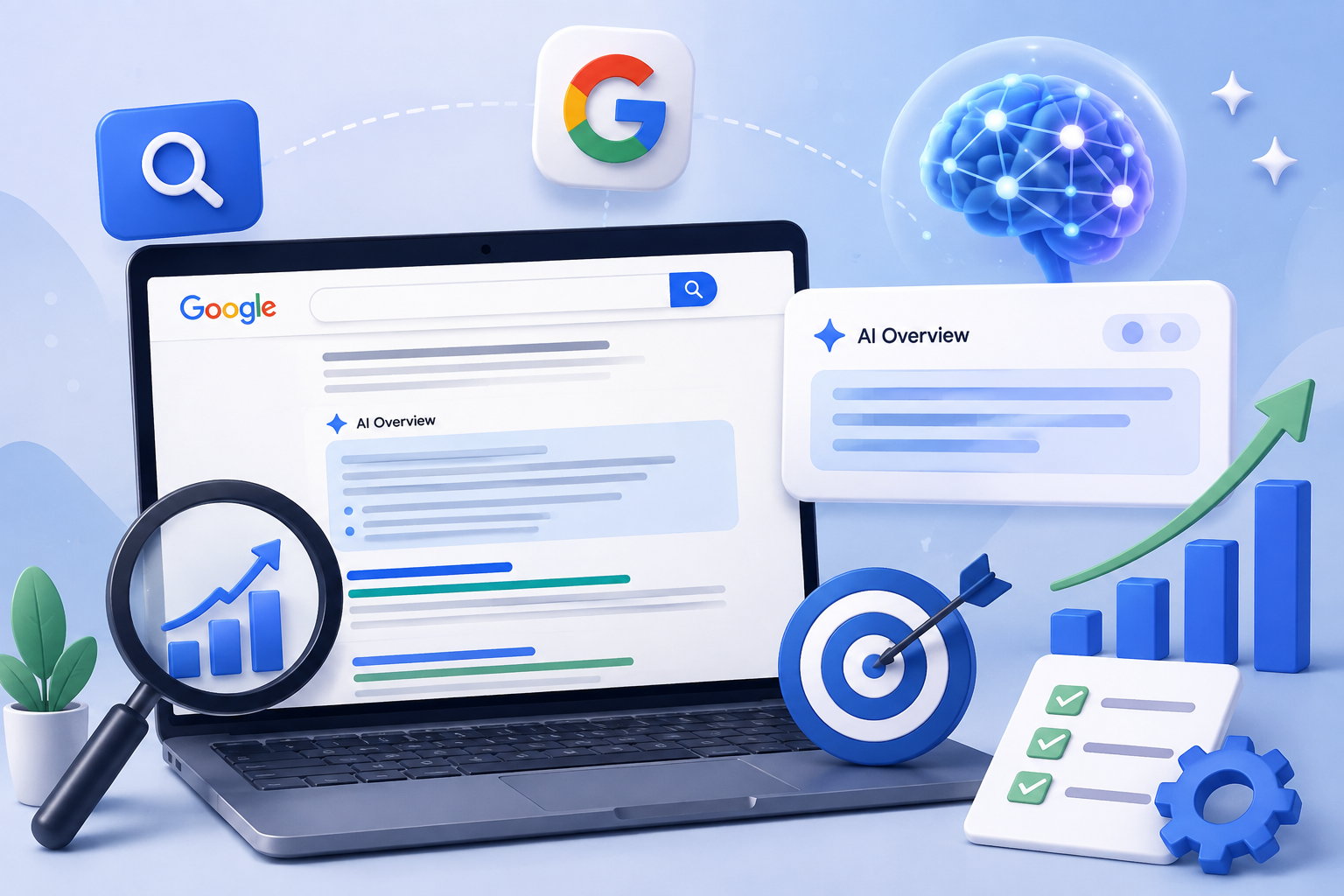
AI Overviews are the AI-generated summary boxes that appear above traditional search results for many queries. Instead of sending users straight to a list of blue links, Google generates a short synthesized answer often pulling and citing two to five sources before the regular organic results appear.
The key thing to understand: AI Overviews are not a separate ranking system. They’re built on top of Google’s existing search index. A page that doesn’t rank organically for a query has almost no chance of being pulled into the AI Overview for that same query. Ranking well first is the prerequisite, not an alternative path.
How AI Overviews Actually Choose Sources
Based on how these systems behave in practice, a few patterns show up consistently across the pages that get selected:
- They already rank on page one. AI Overviews draw heavily from top-10 organic results, so your existing SEO fundamentals still matter.
- They favor a direct, self-contained answer. Pages that state the answer plainly in the opening paragraph before adding context get quoted more often than pages that bury the answer under a long introduction.
- They prefer structured content. Numbered steps, bullet lists, comparison tables, and short definitional paragraphs are easier for the model to lift cleanly than dense narrative prose.
- They reward clear entities and specificity. Content that names concrete tools, numbers, dates, and named concepts (rather than vague generalities) gives the model something precise to extract.
- They lean on trust signals. Author expertise, transparent sourcing, and a site’s overall topical authority in that subject area all factor into which sources get selected as “safe” to summarize.
Step-by-Step Strategy to Get Featured in AI Overviews
GEO vs. AEO vs. Traditional SEO: How They Relate
These terms get used loosely, so it’s worth being precise about what each one actually means and how they fit together:
- Traditional SEO focuses on ranking a page in the standard organic results technical health, backlinks, on-page relevance, and content quality.
- AEO (Answer Engine Optimization) focuses on structuring content so a specific question gets a clean, extractable answer the practice that helps you show up in featured snippets, voice search results, and the “People Also Ask” box, in addition to AI Overviews.
- GEO (Generative Engine Optimization) is the broader discipline of optimizing content to be understood, trusted, and cited by generative AI systems in general this includes AI Overviews, but also tools like ChatGPT search, Perplexity, and Google’s own AI Mode.
In practice, these three aren’t competing strategies they’re layers. Traditional SEO gets you into the top-ranking set. AEO structures your content so a specific passage can be lifted as a direct answer. GEO makes sure the surrounding content is trustworthy and well-sourced enough for a generative system to feel confident citing it. You need all three working together; none of them substitutes for the others.
1. Answer the query in the first 40–60 words
Structure your opening paragraph as a direct, standalone answer assume it might be the only part of your page an AI system reads. Save the elaboration, examples, and nuance for the sections that follow.
2. Build topical authority around the exact subject, not just the exact keyword
AI Overviews (and Google’s ranking systems generally) increasingly evaluate whether an entire site demonstrates depth on a subject not just whether one page contains the right keyword. This is why a proper AI SEO strategy built around topic clusters matters more now than isolated, one-off blog posts. A site that covers a topic from multiple angles tools, strategy, common mistakes, case examples signals real expertise to both Google and generative engines.
For example, a single article titled “AI SEO tips” sitting on a site that otherwise publishes about travel, fashion, and unrelated services carries far less topical weight than the same article sitting on a site with a dozen interlinked articles covering AI SEO tools, keyword research, content strategy, and technical implementation. The individual page hasn’t changed but the site’s demonstrated depth around the subject has, and that context genuinely affects how much Google and generative systems trust any single page on that topic.
3. Use semantic SEO, not just keyword matching
Semantic SEO means writing around the full topic and its related concepts (synonyms, subtopics, commonly-paired entities) instead of repeating one exact phrase. For a page targeting “how to rank in AI overviews,” that means naturally covering related concepts like generative engine optimization (GEO), answer engine optimization (AEO), structured data, and E-E-A-T which is exactly what this article does.
4. Format for extraction, not just for readers
Break down complex explanations into:
- Short paragraphs (2–4 sentences)
- Numbered steps for processes
- Bullet lists for criteria or features
- Tables for comparisons
- A clearly labeled FAQ section
This format doesn’t just help AI systems it also improves normal readability and dwell time, which are both good for organic rankings.
5. Add structured data (schema markup)
Implement Article schema on every post and FAQ schema on any page with a Q&A section. Schema doesn’t guarantee inclusion in AI Overviews, but it removes ambiguity about what your content is and what question each section answers which lowers the barrier for a generative system to use it confidently.
6. Strengthen your E-E-A-T signals
- Add a real author bio with relevant credentials or experience on every post
- Reference original data, first-hand testing, or specific examples rather than generic advice
- Keep an About page that clearly explains who runs the site and why they’re credible on the topic
- Fix or remove thin, unrelated content that dilutes your site’s topical focus (a common issue on newer sites publishing across too many unrelated categories)
7. Earn mentions and citations elsewhere
Sites and content that get referenced, linked to, or discussed elsewhere on the web build the kind of external trust signal that both traditional SEO and generative engines rely on. Digital PR, guest contributions, and being named in industry roundups all help here the same way strong branding and digital identity work strengthens a brand’s overall credibility signals.
8. Keep content current
AI Overviews tend to favor recently updated, dated content for fast-moving topics. Revisit and update key articles every few months refresh statistics, add new sections, and update the published/modified date.
How to Measure Whether It’s Working
There’s no dedicated “AI Overview ranking” report in most analytics tools, so tracking progress takes a bit of manual work:
- Search Console impressions without clicks: A rising impression count on a query paired with flat or falling clicks can indicate your content is being seen (possibly summarized) without driving a visita pattern worth investigating query by query.
- Manual SERP checks: Periodically search your target queries yourself (logged out, in an incognito window) and note whether an AI Overview appears and whether your site is cited.
- Brand mention tracking: Tools that monitor citations across AI platforms (sometimes marketed as “brand radar” or “AI visibility” tools) can show whether your domain is being referenced in AI-generated answers over time.
- Organic ranking movement: Since AI Overviews pull from organic results, improvements in your standard rankings for a query are a leading indicator that inclusion is becoming more likely.
Quick Implementation Checklist
- [ ] Opening paragraph answers the core query in 40–60 words
- [ ] Content broken into short paragraphs, lists, and at least one table where relevant
- [ ] Article schema and FAQ schema (where applicable) implemented
- [ ] Author bio with real credentials visible on the post
- [ ] At least 2–3 internal links to related content within the same silo
- [ ] Content reviewed and refreshed within the last 3–6 months
- [ ] Site’s overall category is topically focused, without unrelated off-topic content diluting authority
Common Mistakes That Keep Sites Out of AI Overviews
| Mistake | Why It Hurts |
| Burying the answer under a long intro | AI systems can’t find a clean passage to quote |
| Publishing across unrelated topics | Weakens topical authority signals for any single subject |
| No author information | Weakens E-E-A-T trust signals |
| No schema markup | Adds ambiguity about page/content type |
| Thin, generic content | Nothing specific enough to extract or cite |
| Never updating old posts | Signals the content may be outdated |
FAQ: Ranking in Google AI Overviews
Does ranking #1 organically guarantee an AI Overview feature? No. AI Overviews typically pull from several top-ranking pages, not just position one, and selection depends on which page answers the query most directly and clearly not purely on ranking position.
Is GEO (Generative Engine Optimization) different from traditional SEO? GEO builds on traditional SEO rather than replacing it. It adds an extra layer: structuring content so it can be easily extracted and cited by generative systems, on top of the ranking fundamentals SEO already requires.