AI Assistant vs Virtual Assistant: Which Tasks Need a Real Person?
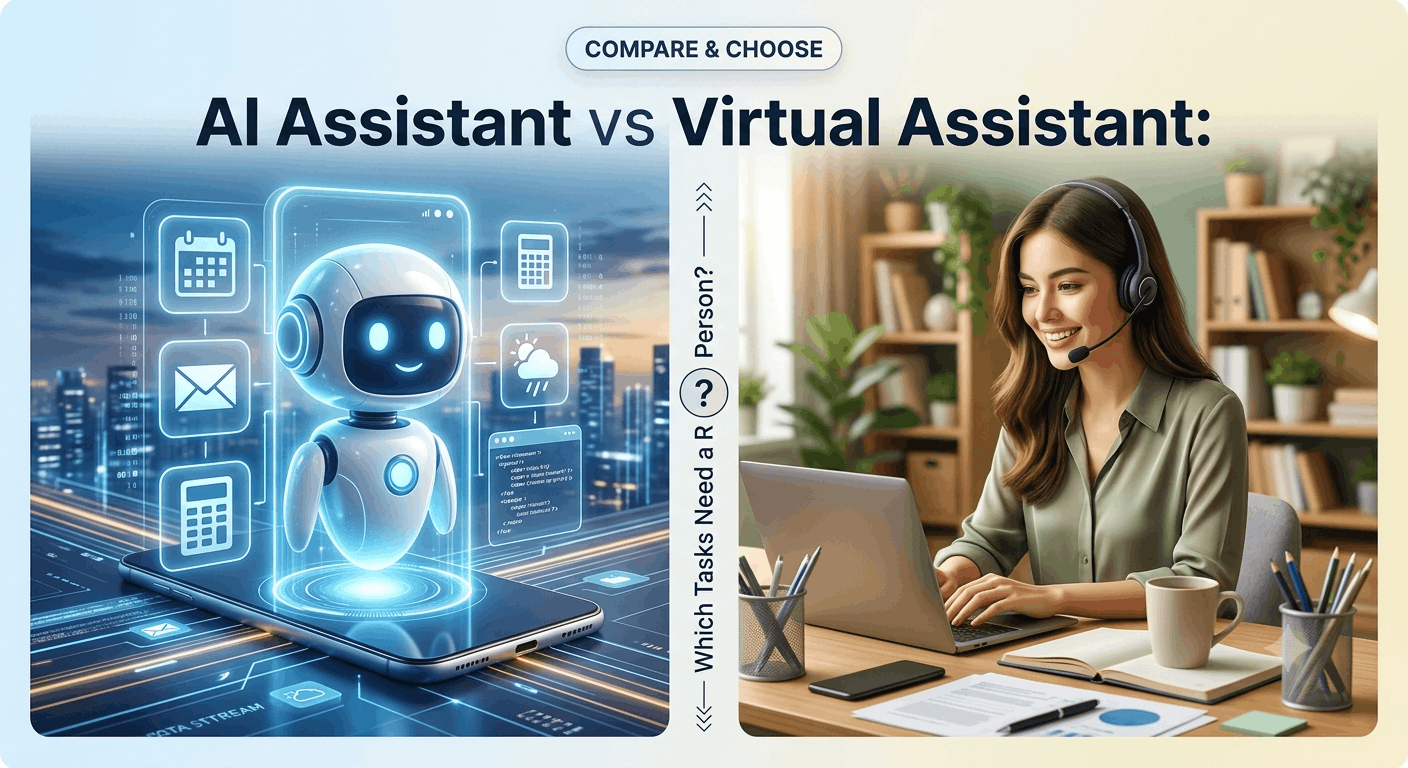
An AI assistant is best for fast, repeatable and rules-based tasks. A human virtual assistant is better for work involving judgment, empathy, responsibility, client relationships or unexpected problems.
Most businesses do not need to choose only one. The best approach is often to let AI prepare, organize or automate the work while a real person reviews the output, handles exceptions and takes responsibility for the final result.
This guide compares an AI assistant vs virtual assistant and explains which tasks can be automated, which still need a human and when a combined approach makes the most sense.
What Is an AI Assistant?
An AI assistant is a software tool that uses artificial intelligence to help users complete tasks.
It can understand instructions, process information, generate content and sometimes perform actions inside connected business applications.
Common AI assistant tasks include:
- Drafting emails
- Summarizing documents
- Organizing information
- Categorizing support requests
- Creating meeting notes
- Answering common questions
- Generating reports
- Extracting data
- Suggesting next steps
- Automating routine workflows
An AI assistant normally responds to instructions provided by a user. More advanced systems may plan and complete several connected steps.
To understand the difference between basic assistants and autonomous systems, read this guide explaining what an artificial intelligence agent is.
AI can work quickly, but speed does not always mean accuracy. Its results depend on the instructions, available information, system access and review process.
What Is a Human Virtual Assistant?
A human virtual assistant is a real person who works remotely and supports a business with administrative, creative, technical or customer-facing tasks.
A human VA may help with:
- Inbox management
- Calendar scheduling
- Customer support
- Lead follow-ups
- Data entry
- CRM management
- Online research
- Recruitment support
- Social media management
- E-commerce operations
- Report preparation
- Vendor communication
- Project coordination
Unlike an AI tool, a human virtual assistant can ask questions, understand changing priorities and notice when a situation does not follow the usual process.
A VA can also take ownership of a task and explain what was completed, what went wrong and what should happen next.
Businesses considering remote support can review The Slylar Box’s detailed guide on how to hire a virtual assistant.
AI Assistant vs Virtual Assistant: Quick Comparison
| Area | AI assistant | Human virtual assistant |
|---|---|---|
| Type | Software | Real remote professional |
| Speed | Very fast | Works at a human pace |
| Availability | Can operate continuously | Works agreed hours |
| Repetitive work | Very effective | Can complete it but may take longer |
| Human judgment | Limited | Stronger |
| Emotional understanding | Can copy an empathetic tone | Can understand human concerns |
| Unexpected problems | May struggle outside its rules | Can investigate and adapt |
| Relationship building | Limited | Strong |
| Accountability | Business remains responsible | A named person can own the task |
| Quality control | Needs review systems | Can review and correct output |
| Best use | Automation and first drafts | Judgment, communication and execution |
Tasks an AI Assistant Can Handle Well
AI is most useful when a task follows clear rules and the result is easy to review.
Creating First Drafts
An AI assistant can produce first drafts of:
- Routine emails
- Social media captions
- Product descriptions
- Meeting agendas
- Internal updates
- Blog outlines
- Customer-service replies
This can save time, especially when a business needs several versions of similar content.
However, a person should review important content before it is published or sent to a customer. The reviewer should check facts, tone, pricing, promises and confidential information.
Summarizing Information
AI can quickly summarize:
- Long email conversations
- Meeting transcripts
- Research documents
- Customer feedback
- Project notes
- Reports
These summaries can help a team identify key points without reading every line first.
For important decisions, the original source should still be checked. AI may leave out a detail that appears minor but changes the meaning of the information.
Sorting and Categorizing Data
AI can help organize:
- Support tickets
- Customer inquiries
- Leads
- Survey responses
- Expense descriptions
- Documents
- CRM records
This works best when the business defines clear categories and sends unusual cases to a human reviewer.
Answering Common Questions
An AI assistant or chatbot may answer predictable questions such as:
- What are your business hours?
- How can I reset my password?
- Where is my order?
- What services do you provide?
- How can I book an appointment?
AI can provide an immediate response at any time. However, customers should always have a clear way to reach a person when the question is unusual or sensitive.
Automating Routine Workflows
AI assistants can work with automation platforms to move information between different applications.
For example, a workflow may:
- Receive a website inquiry
- Identify the type of request
- Add the lead to a CRM
- Draft a follow-up email
- Notify the sales team
Businesses exploring these systems can compare the best AI workflow automation tools for different team sizes and technical requirements.
Tasks That Still Need a Real Person
Some tasks involve too much risk, emotion or uncertainty to be fully assigned to AI.
Handling Customer Complaints
An angry customer may not only need information. They may want someone to understand what happened and take responsibility for solving it.
A human virtual assistant can:
- Listen to the customer
- Review previous communication
- Ask follow-up questions
- Adjust the tone
- Offer an approved solution
- Escalate serious problems
- Protect the customer relationship
AI may prepare a draft, but complaints involving refunds, financial loss, legal threats or public criticism should be reviewed by a person.
Managing Priorities
Business priorities are not always written in a clear set of rules.
A founder may receive several urgent requests at the same time. A human VA can consider:
- Which client is most important
- Which deadline has the greatest impact
- Which meeting can safely be moved
- Which issue needs the founder’s attention
- What was promised in earlier conversations
AI can organize the information, but a person should make the final decision when priorities conflict.
Writing Sensitive Messages
A human should write or approve communication involving:
- Employee performance
- Contract disputes
- Payment problems
- Customer complaints
- Partnership negotiations
- Recruitment decisions
- Confidential business matters
- Crisis communication
These messages require more than correct grammar. They require timing, discretion, empathy and an understanding of how the recipient may respond.
Building Client Relationships
Strong client relationships develop through trust, consistency and personal understanding.
A human VA can remember:
- How a client prefers to communicate
- Which topics are sensitive
- What was promised during the last meeting
- When a phone call is better than an email
- Which issues require immediate attention
- How formal or direct a message should be
AI can store notes and suggest responses, but relationship ownership should remain with a real person.
Handling Unclear Instructions
Managers do not always provide complete instructions.
A business owner might say:
“Please solve the scheduling problem and make sure the client is satisfied.”
A human virtual assistant can investigate what happened, contact the people involved, compare possible solutions and ask for approval when needed.
An AI system may struggle unless it has detailed instructions, access to all relevant information and clear rules for every possible situation.
Reviewing AI-Generated Work
AI output can contain:
- Incorrect facts
- Missing details
- Repeated information
- Weak reasoning
- Unnatural wording
- Brand inconsistencies
- Confidential data
- Unsupported recommendations
Human review is therefore not an optional extra for important work. It is part of the workflow.
A virtual assistant can check the result, compare it with the original information and correct problems before the content reaches a customer.
Taking Responsibility
An AI tool cannot accept responsibility in the same way a business owner, employee or contractor can.
A human virtual assistant can:
- Confirm task completion
- Explain a decision
- Report a mistake
- Correct the problem
- Follow an approval process
- Escalate risk
- Learn from feedback
- Keep records of completed work
Every important workflow should still have a named human owner.
Tasks That Work Best With AI and a Human Together
The most useful question is not whether AI will replace a virtual assistant.
The better question is:
Which part should AI complete, and which part should a person control?
Email Management
AI can:
- Label messages
- Summarize long threads
- Identify possible spam
- Draft replies
A human VA can:
- Check the full context
- Adjust the tone
- Send the final response
- Escalate important messages
Customer Support
AI can:
- Answer common questions
- Collect basic customer details
- Suggest relevant help articles
- Categorize support tickets
A human VA can:
- Handle complaints
- Process unusual requests
- Manage refunds
- Protect customer relationships
Content Creation
AI can:
- Generate topic ideas
- Create outlines
- Produce first drafts
- Suggest headlines
A human VA can:
- Verify facts
- Improve brand voice
- Add original examples
- Edit and publish the content
Recruitment
AI can:
- Organize applications
- Extract candidate information
- Prepare interview questions
- Schedule reminders
A human VA can:
- Communicate with candidates
- Handle sensitive questions
- Coordinate interviews
- Protect the candidate experience
AI is already changing recruitment workflows, but hiring decisions still need clear human responsibility. Learn more in this guide on how AI is changing hiring and recruiting.
Lead Generation
AI can:
- Organize prospect information
- Categorize leads
- Draft outreach messages
- Create follow-up reminders
A human VA can:
- Verify lead quality
- Personalize communication
- Respond to questions
- Manage sales relationships
Reporting
AI can:
- Collect data
- Identify patterns
- Build first-draft summaries
- Format reports
A human VA can:
- Check accuracy
- Explain unusual results
- Add business context
- Recommend the next action
How to Decide Which Option a Task Needs
Use the following five-question test.
Is the task repeatable?
A highly repeatable task may be suitable for AI or workflow automation.
Are the instructions clear?
AI works best when the inputs, rules and expected results are clearly defined.
What happens if the result is wrong?
An incorrect internal draft may have limited impact. An incorrect invoice, customer promise or financial report can create a serious problem.
Does the task affect a relationship?
Work involving customers, employees, partners and suppliers usually needs human involvement.
Who will own the final result?
Every important workflow should have a person responsible for reviewing the outcome and correcting errors.
| Type of task | Best option |
|---|---|
| Clear, repetitive and low risk | AI assistant |
| Unclear, sensitive or high risk | Human virtual assistant |
| Repetitive with a meaningful cost of error | AI with human review |
| Customer-facing communication | Human approval |
| Financial, legal, medical or employment decisions | Qualified human decision-maker |
AI Assistant vs Virtual Assistant for Small Businesses
Small businesses often have limited time, staff and budgets. This makes both AI and virtual assistants useful, but they solve different problems.
AI may be the better starting point when a business needs to:
- Generate basic drafts
- Summarize information
- Sort large amounts of data
- Automate simple workflows
- Answer common questions
A human VA may be the better choice when the business needs to:
- Communicate with customers
- Manage several changing priorities
- Follow up with leads
- Coordinate projects
- Handle confidential work
- Take responsibility for results
Businesses that need reliable human support can hire a skilled virtual assistant for administrative, customer-service, marketing and operational tasks.
This link should appear only once in the article so it remains natural and does not make the guest post look overly promotional.
Data Privacy and Business Security
Businesses should not give an AI tool unlimited access to emails, customer information, financial records or internal documents.
Before using an AI assistant, decide:
- What information the tool can access
- Which actions it can perform
- Whether a human must approve actions
- Where business data is stored
- How activity will be recorded
- How access will be removed
- What happens when the system makes a mistake
The same principle applies to human virtual assistants. They should only receive the system access needed for their assigned responsibilities.
Use separate accounts, strong passwords, multi-factor authentication and clear access rules for both AI tools and remote workers.
What Is the Best Approach?
For most businesses, the strongest approach is a hybrid system.
AI handles speed, volume and repetitive processing. A human virtual assistant handles judgment, quality control, communication and unexpected situations.
A simple hybrid workflow may look like this:
- AI receives and categorizes a request.
- AI prepares a suggested response.
- A virtual assistant checks the details.
- The VA corrects the tone or information.
- The VA sends the response or asks a manager for approval.
This structure saves time without removing human responsibility.
Final Verdict
In the AI assistant vs virtual assistant comparison, neither option is better for every task.
AI assistants are best for repetitive, structured and low-risk work. Human virtual assistants are better for judgment, empathy, accountability, relationship management and situations that do not follow a predictable process.
Small businesses can gain the most value by combining both.
Let AI organize, summarize and prepare the work. Let a real person review the result, manage exceptions and take responsibility for the final action.
The goal is not to automate every human task. It is to use AI where it improves speed while keeping human judgment wherever it protects quality, customers and business decisions.
Frequently Asked Questions
What is the main difference between an AI assistant and a virtual assistant?
An AI assistant is software that completes or supports tasks. A virtual assistant is a real remote professional. AI is stronger at repetitive processing, while a human VA is stronger at communication, judgment and responsibility.
Can an AI assistant replace a human virtual assistant?
AI can replace parts of a VA’s workload, particularly repetitive tasks. It cannot safely replace every task involving relationships, sensitive communication, unclear instructions or high-impact decisions.
What tasks should not be fully automated?
Customer complaints, employment decisions, negotiations, confidential communication and final financial, medical or legal decisions should involve an authorized human.
Is AI cheaper than hiring a virtual assistant?
AI software may cost less for a narrow task. However, businesses should also consider setup, integration, monitoring, subscriptions, corrections and human review when calculating the total cost.
Can a virtual assistant use AI tools?
Yes. A virtual assistant can use AI for drafting, summaries, data organization and automation while checking accuracy and controlling the final result.
Which option is best for customer support?
AI is useful for answering common questions and collecting basic information. A human virtual assistant is better for complaints, unusual cases, refunds and sensitive customer conversations.
How do I know when a task needs a real person?
A task needs a human when it involves unclear instructions, sensitive information, relationship impact, independent judgment or a high cost if something goes wrong.